


Page 75 - Read Online
P. 75
Page 12 of 47                                                         Zhou et al. Soft Sci. 2026, 6, 10


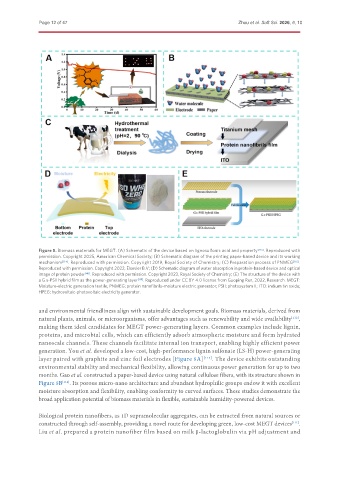
               Figure 5. Biomass materials for MEGT. (A) Schematic of the device based on lignosulfonic acid and property  [113] . Reproduced with
               permission. Copyright 2025, American Chemical Society; (B) Schematic diagram of the printing paper-based device and its working
               mechanism [114] . Reproduced with permission. Copyright 2019, Royal Society of Chemistry; (C) Preparation process of PNMEG [115] .
               Reproduced with permission. Copyright 2022, Elsevier B.V; (D) Schematic diagram of water absorption in protein-based device and optical
               image of protein powder [40] . Reproduced with permission. Copyright 2023, Royal Society of Chemistry; (E) The structure of the device with
               a G.s-PSII hybrid film as the power-generating layer [119] . Reproduced under CC BY 4.0 license from Guoping Ren, 2022, Research. MEGT:
               Moisture-electric generation textile; PNMEG: protein nanofibrils-moisture electric generator; PSII: photosystem II; ITO: indium tin oxide;
               HPEG: hydrovoltaic-photovoltaic electricity generator.


               and environmental friendliness align with sustainable development goals. Biomass materials, derived from
               natural plants, animals, or microorganisms, offer advantages such as renewability and wide availability [112] ,
               making them ideal candidates for MEGT power-generating layers. Common examples include lignin,
               proteins, and microbial cells, which can efficiently adsorb atmospheric moisture and form hydrated
               nanoscale channels. These channels facilitate internal ion transport, enabling highly efficient power
               generation. You et al. developed a low-cost, high-performance lignin sulfonate (LS-H) power-generating
               layer paired with graphite and zinc foil electrodes [Figure 5A] [113] . The device exhibits outstanding
               environmental stability and mechanical flexibility, allowing continuous power generation for up to two
               months. Gao et al. constructed a paper-based device using natural cellulose fibers, with its structure shown in
               Figure 5B . Its porous micro-nano architecture and abundant hydrophilic groups endow it with excellent
                       [114]
               moisture absorption and flexibility, enabling conformity to curved surfaces. These studies demonstrate the
               broad application potential of biomass materials in flexible, sustainable humidity-powered devices.


               Biological protein nanofibers, as 1D supramolecular aggregates, can be extracted from natural sources or
               constructed through self-assembly, providing a novel route for developing green, low-cost MEGT devices .
                                                                                                        [111]
               Liu et al. prepared a protein nanofiber film based on milk β-lactoglobulin via pH adjustment and

