


Page 70 - Read Online
P. 70
Zhou et al. Soft Sci. 2026, 6, 10                                                  Page 7 of 47


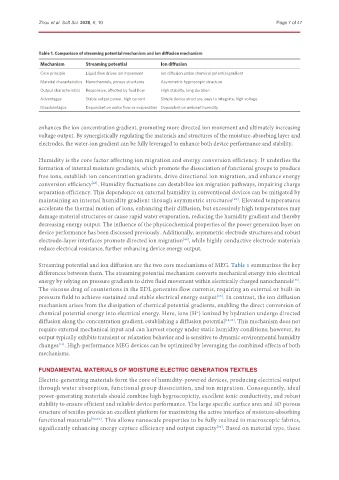
               Table 1. Comparison of streaming potential mechanism and ion diffusion mechanism
               Mechanism       Streaming potential       Ion diffusion

               Core principle  Liquid flow drives ion movement  Ion diffusion under chemical potential gradient
               Material characteristics Nanochannels, porous structures  Asymmetric hygroscopic structure
               Output characteristics  Responsive, affected by fluid flow  High stability, long duration
               Advantages      Stable output power, high current  Simple device structure, easy to integrate, high voltage
               Disadvantages   Dependent on water flow or evaporation Dependent on ambient humidity


               enhances the ion concentration gradient, promoting more directed ion movement and ultimately increasing
               voltage output. By synergistically regulating the materials and structures of the moisture-absorbing layer and
               electrodes, the water-ion gradient can be fully leveraged to enhance both device performance and stability.


               Humidity is the core factor affecting ion migration and energy conversion efficiency. It underlies the
               formation of internal moisture gradients, which promote the dissociation of functional groups to produce
               free ions, establish ion concentration gradients, drive directional ion migration, and enhance energy
               conversion efficiency . Humidity fluctuations can destabilize ion migration pathways, impairing charge
                                 [45]
               separation efficiency. This dependence on external humidity in conventional devices can be mitigated by
               maintaining an internal humidity gradient through asymmetric structures . Elevated temperatures
                                                                                   [88]
               accelerate the thermal motion of ions, enhancing their diffusion, but excessively high temperatures may
               damage material structures or cause rapid water evaporation, reducing the humidity gradient and thereby
               decreasing energy output. The influence of the physicochemical properties of the power generation layer on
               device performance has been discussed previously. Additionally, asymmetric electrode structures and robust
               electrode–layer interfaces promote directed ion migration , while highly conductive electrode materials
                                                                 [89]
               reduce electrical resistance, further enhancing device energy output.

               Streaming potential and ion diffusion are the two core mechanisms of MEG. Table 1 summarizes the key
               differences between them. The streaming potential mechanism converts mechanical energy into electrical
               energy by relying on pressure gradients to drive fluid movement within electrically charged nanochannels .
                                                                                                        [45]
               The viscous drag of counterions in the EDL generates flow currents, requiring an external or built-in
               pressure field to achieve sustained and stable electrical energy output . In contrast, the ion diffusion
                                                                             [65]
               mechanism arises from the dissipation of chemical potential gradients, enabling the direct conversion of
               chemical potential energy into electrical energy. Here, ions (H ) ionized by hydration undergo directed
                                                                      +
               diffusion along the concentration gradient, establishing a diffusion potential [18,35] . This mechanism does not
               require external mechanical input and can harvest energy under static humidity conditions; however, its
               output typically exhibits transient or relaxation behavior and is sensitive to dynamic environmental humidity
               changes . High-performance MEG devices can be optimized by leveraging the combined effects of both
                      [12]
               mechanisms.

               FUNDAMENTAL MATERIALS OF MOISTURE ELECTRIC GENERATION TEXTILES
               Electric-generating materials form the core of humidity-powered devices, producing electrical output
               through water absorption, functional group dissociation, and ion migration. Consequently, ideal
               power-generating materials should combine high hygroscopicity, excellent ionic conductivity, and robust
               stability to ensure efficient and reliable device performance. The large specific surface area and 3D porous
               structure of textiles provide an excellent platform for maximizing the active interface of moisture-absorbing
               functional materials [90,91] . This allows nanoscale properties to be fully realized in macroscopic fabrics,
               significantly enhancing energy capture efficiency and output capacity . Based on material type, these
                                                                             [92]

