


Page 59 - Read Online
P. 59
Zhao et al. Soft Sci. 2026, 6, 4                                                 Page 11 of 15


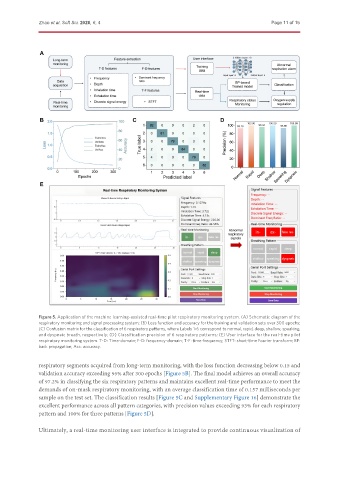
               Figure 5. Application of the machine learning-assisted real-time pilot respiratory monitoring system. (A) Schematic diagram of the
               respiratory monitoring and signal processing system; (B) Loss function and accuracy for the training and validation sets over 300 epochs;
               (C) Confusion matrix for the classification of 6 respiratory patterns, where Labels 1-6 correspond to normal, rapid, deep, shallow, speaking,
               and dyspneic breath, respectively; (D) Classification precision of 6 respiratory patterns; (E) User interface for the real-time pilot
               respiratory monitoring system. T-D: Time-domain; F-D: frequency-domain; T-F: time-frequency; STFT: short-time Fourier transform; BP:
               back propagation; Acc: accuracy.


               respiratory segments acquired from long-term monitoring, with the loss function decreasing below 0.15 and
               validation accuracy exceeding 95% after 300 epochs [Figure 5B]. The final model achieves an overall accuracy
               of 97.2% in classifying the six respiratory patterns and maintains excellent real-time performance to meet the
               demands of on-mask respiratory monitoring, with an average classification time of 0.157 milliseconds per
               sample on the test set. The classification results [Figure 5C and Supplementary Figure 16] demonstrate the
               excellent performance across all pattern categories, with precision values exceeding 93% for each respiratory
               pattern and 100% for three patterns [Figure 5D].

               Ultimately, a real-time monitoring user interface is integrated to provide continuous visualization of

