


Page 58 - Read Online
P. 58
Page 10 of 15                                                         Zhao et al. Soft Sci. 2026, 6, 4


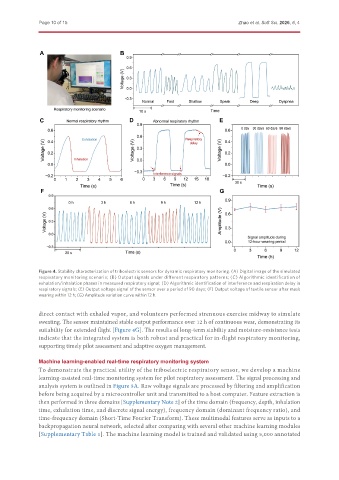
               Figure 4. Stability characterization of triboelectric sensors for dynamic respiratory monitoring. (A) Digital image of the simulated
               respiratory monitoring scenario; (B) Output signals under different respiratory patterns; (C) Algorithmic identification of
               exhalation/inhalation phases in measured respiratory signal; (D) Algorithmic identification of interference and respiration delay in
               respiratory signals; (E) Output voltage signal of the sensor over a period of 90 days; (F) Output voltage of textile sensor after mask
               wearing within 12 h; (G) Amplitude variation curve within 12 h.


               direct contact with exhaled vapor, and volunteers performed strenuous exercise midway to simulate
               sweating. The sensor maintained stable output performance over 12 h of continuous wear, demonstrating its
               suitability for extended flight [Figure 4G]. The results of long-term stability and moisture-resistance tests
               indicate that the integrated system is both robust and practical for in-flight respiratory monitoring,
               supporting timely pilot assessment and adaptive oxygen management.

               Machine learning-enabled real-time respiratory monitoring system
               To demonstrate the practical utility of the triboelectric respiratory sensor, we develop a machine
               learning-assisted real-time monitoring system for pilot respiratory assessment. The signal processing and
               analysis system is outlined in Figure 5A. Raw voltage signals are processed by filtering and amplification
               before being acquired by a microcontroller unit and transmitted to a host computer. Feature extraction is
               then performed in three domains [Supplementary Note 2] of the time domain (frequency, depth, inhalation
               time, exhalation time, and discrete signal energy), frequency domain (dominant frequency ratio), and
               time-frequency domain (Short-Time Fourier Transform). These multimodal features serve as inputs to a
               backpropagation neural network, selected after comparing with several other machine learning modules
               [Supplementary Table 1]. The machine learning model is trained and validated using 5,000 annotated

