


Page 55 - Read Online
P. 55
Zhao et al. Soft Sci. 2026, 6, 4                                                  Page 7 of 15


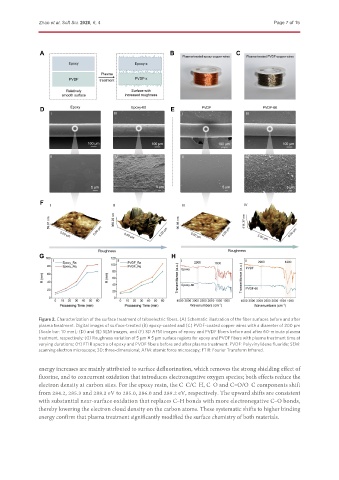
               Figure 2. Characterization of the surface treatment of triboelectric fibers. (A) Schematic illustration of the fiber surfaces before and after
               plasma treatment. Digital images of surface-treated (B) epoxy-coated and (C) PVDF-coated copper wires with a diameter of 200 μm
               (Scale bar: 10 mm); (D) and (E) SEM images, and (F) 3D AFM images of epoxy and PVDF fibers before and after 60-minute plasma
               treatment, respectively; (G) Roughness variation of 5 μm × 5 μm surface regions for epoxy and PVDF fibers with plasma treatment time at
               varying durations; (H) FTIR spectra of epoxy and PVDF fibers before and after plasma treatment. PVDF: Polyvinylidene fluoride; SEM:
               scanning electron microscope; 3D: three-dimensional; AFM: atomic force microscopy; FTIR: Fourier Transform Infrared.


               energy increases are mainly attributed to surface defluorination, which removes the strong shielding effect of
               fluorine, and to concurrent oxidation that introduces electronegative oxygen species; both effects reduce the
               electron density at carbon sites. For the epoxy resin, the C–C/C–H, C–O and C=O/O–C components shift
               from 284.2, 285.3 and 288.2 eV to 285.0, 286.0 and 289.2 eV, respectively. The upward shifts are consistent
               with substantial near-surface oxidation that replaces C–H bonds with more electronegative C–O bonds,
               thereby lowering the electron cloud density on the carbon atoms. These systematic shifts to higher binding
               energy confirm that plasma treatment significantly modified the surface chemistry of both materials.

