


Page 56 - Read Online
P. 56
Page 8 of 15                                                          Zhao et al. Soft Sci. 2026, 6, 4


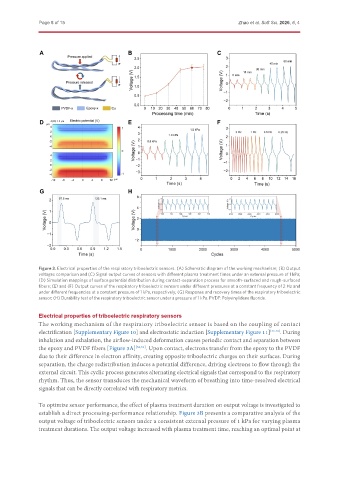
               Figure 3. Electrical properties of the respiratory triboelectric sensors. (A) Schematic diagram of the working mechanism; (B) Output
               voltages comparison and (C) Signal output curves of sensors with different plasma treatment times under an external pressure of 1 kPa;
               (D) Simulation mappings of surface potential distribution during contact-separation process for smooth-surfaced and rough-surfaced
               fibers; (E) and (F) Output curves of the respiratory triboelectric sensors under different pressures at a constant frequency of 2 Hz and
               under different frequencies at a constant pressure of 1 kPa, respectively; (G) Response and recovery times of the respiratory triboelectric
               sensor; (H) Durability test of the respiratory triboelectric sensor under a pressure of 1 kPa. PVDF: Polyvinylidene fluoride.

               Electrical properties of triboelectric respiratory sensors
               The working mechanism of the respiratory triboelectric sensor is based on the coupling of contact
               electrification [Supplementary Figure 10] and electrostatic induction [Supplementary Figure 11] [47-49] . During
               inhalation and exhalation, the airflow-induced deformation causes periodic contact and separation between
               the epoxy and PVDF fibers [Figure 3A] [50,51] . Upon contact, electrons transfer from the epoxy to the PVDF
               due to their difference in electron affinity, creating opposite triboelectric charges on their surfaces. During
               separation, the charge redistribution induces a potential difference, driving electrons to flow through the
               external circuit. This cyclic process generates alternating electrical signals that correspond to the respiratory
               rhythm. Thus, the sensor transduces the mechanical waveform of breathing into time-resolved electrical
               signals that can be directly correlated with respiratory metrics.


               To optimize sensor performance, the effect of plasma treatment duration on output voltage is investigated to
               establish a direct processing-performance relationship. Figure 3B presents a comparative analysis of the
               output voltage of triboelectric sensors under a consistent external pressure of 1 kPa for varying plasma
               treatment durations. The output voltage increased with plasma treatment time, reaching an optimal point at

