


Page 64 - Read Online
P. 64
Review Article  |  Open Access

                                                   Soft Science


                                              Zhou et al. Soft Sci. 2026, 6, 10      DOI:10.20517/ss.2025.96


               Moisture-electric generation textiles for wearable
               energy devices: materials, structures, manufacturing,
               and applications


               Qiuyu Zhou, Mengyu Du, Zhenyun Zhao, Wei Chen *

               Keywords:
               Moisture-electric generation
               textiles, electric generation
               materials, manufacturing
               technologies, device
               structures, wearable
               applications

               Citation: Zhou, Q.; Du, M.;
               Zhao, Z.; Chen, W.
               Moisture-electric generation
               textiles for wearable energy
               devices: materials,
               structures, manufacturing,
               and applications. Soft Sci.
               2026, 6, 10.
               https://dx.doi.org/10.20517
               /ss.2025.96
                                   Abstract
               Received: 29 Sep 2025
               First Decision: 11 Nov  Moisture-electric generators, as an environmentally friendly energy-harvesting technology,
               2025                operate  independently  of  external  conditions  such  as  sunlight,  water  droplets,  or  wind,
               Revised: 25 Nov 2025  thereby overcoming the limitations of traditional energy sources. Moisture from the air is
               Accepted: 8 Dec 2025  captured   by   a   functional   power-generation   layer,   where   phase   transitions   of   water
               Published: 28 Jan 2026
                                   molecules   occur,   enabling   the   effective   conversion   of   the   released   chemical   potential
               Academic Editors:   energy  into  electrical  energy.  Moisture-electric  generation  textiles  (MEGTs)  inherently
               Xinge YU, Jun Chen  exhibit flexibility, breathability, and biocompatibility, demonstrating significant potential as
               Copy Editor:
               Pei-Yun Wang        self-sustainable   power   sources   for   wearable   electronics.   Through   feasible   integration
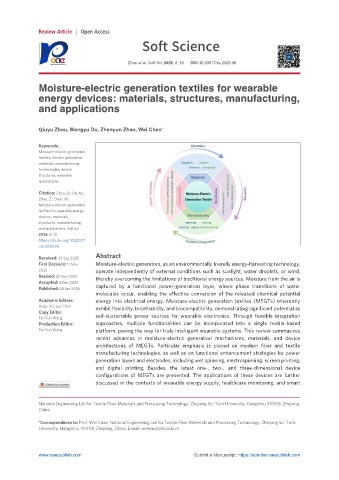
               Production Editor:  approaches,   multiple   functionalities   can   be   incorporated   into   a   single   textile-based
               Pei-Yun Wang        platform, paving the way for truly intelligent wearable systems. This review summarizes
                                   recent   advances   in   moisture-electric   generation   mechanisms,   materials,   and   device
                                   architectures   of   MEGTs.   Particular   emphasis   is   placed   on   modern   fiber   and   textile
                                   manufacturing technologies, as well as on functional enhancement strategies for power
                                   generation layers and electrodes, including wet spinning, electrospinning, screen printing,
                                   and   digital   printing.   Besides,   the   latest   one-,   two-,   and   three-dimensional   device
                                   configurations   of   MEGTs   are   presented.   The   applications   of   these   devices   are   further
                                   discussed  in  the  contexts  of  wearable  energy  supply,  healthcare  monitoring,  and  smart


               National Engineering Lab for Textile Fiber Materials and Processing Technology, Zhejiang Sci-Tech University, Hangzhou 310018, Zhejiang,
               China.

               * Correspondence to: Prof. Wei Chen, National Engineering Lab for Textile Fiber Materials and Processing Technology, Zhejiang Sci-Tech
               University, Hangzhou 310018, Zhejiang, China. E-mail: wchen@zstu.edu.cn


               www.oaepublish.com                                    Submit a Manuscript: https://ucenter.oaepublish.com

