


Page 84 - Read Online
P. 84
Page 8 of 13                           Zhao et al. Soft Sci. 2025, 5, 10  https://dx.doi.org/10.20517/ss.2024.61


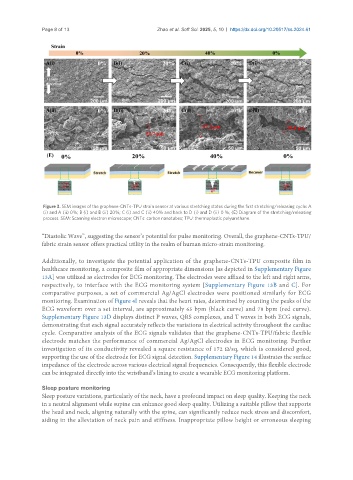
                Figure 3. SEM images of the graphene-CNTs-TPU strain sensor at various stretching states during the first stretching/releasing cycle: A
                (i) and A (ii) 0%; B (i) and B (ii) 20%; C (i) and C (ii) 40% and back to D (i) and D (ii) 0 %; (E) Diagram of the stretching/releasing
                process. SEM: Scanning electron microscope; CNTs: carbon nanotubes; TPU: thermoplastic polyurethane.

               “Diastolic Wave”, suggesting the sensor’s potential for pulse monitoring. Overall, the graphene-CNTs-TPU/
               fabric strain sensor offers practical utility in the realm of human micro-strain monitoring.


               Additionally, to investigate the potential application of the graphene-CNTs-TPU composite film in
               healthcare monitoring, a composite film of appropriate dimensions [as depicted in Supplementary Figure
               13A] was utilized as electrodes for ECG monitoring. The electrodes were affixed to the left and right arms,
               respectively, to interface with the ECG monitoring system [Supplementary Figure 13B and C]. For
               comparative purposes, a set of commercial Ag/AgCl electrodes were positioned similarly for ECG
               monitoring. Examination of Figure 4I reveals that the heart rates, determined by counting the peaks of the
               ECG waveform over a set interval, are approximately 65 bpm (black curve) and 78 bpm (red curve).
               Supplementary Figure 13D displays distinct P waves, QRS complexes, and T waves in both ECG signals,
               demonstrating that each signal accurately reflects the variations in electrical activity throughout the cardiac
               cycle. Comparative analysis of the ECG signals validates that the graphene-CNTs-TPU/fabric flexible
               electrode matches the performance of commercial Ag/AgCl electrodes in ECG monitoring. Further
               investigation of its conductivity revealed a square resistance of 172 Ω/sq, which is considered good,
               supporting the use of the electrode for ECG signal detection. Supplementary Figure 14 illustrates the surface
               impedance of the electrode across various electrical signal frequencies. Consequently, this flexible electrode
               can be integrated directly into the wristband’s lining to create a wearable ECG monitoring platform.

               Sleep posture monitoring
               Sleep posture variations, particularly of the neck, have a profound impact on sleep quality. Keeping the neck
               in a neutral alignment while supine can enhance good sleep quality. Utilizing a suitable pillow that supports
               the head and neck, aligning naturally with the spine, can significantly reduce neck stress and discomfort,
               aiding in the alleviation of neck pain and stiffness. Inappropriate pillow height or erroneous sleeping

