


Page 49 - Read Online
P. 49
Wang et al. Soft Sci 2024;4:41  https://dx.doi.org/10.20517/ss.2024.53          Page 31 of 43


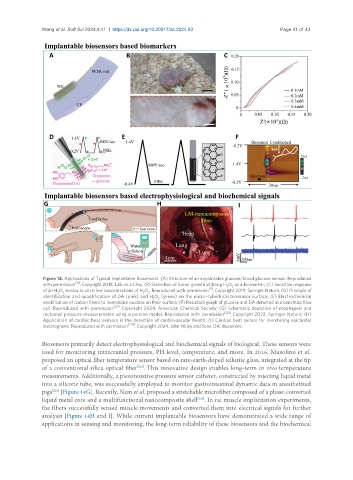
                Figure 14. Applications of Typical Implantable Biosensors. (A) Structure of an implantable glucose/blood glucose sensor. Reproduced
                          [12]
                with permission  . Copyright 2018, Lab on a Chip; (B) Detection of tumor growth utilizing H O  as a biomarker; (C) Sensitive response
                                                                             2  2
                                                                       [11]
                of an H O  sensor to ultra-low concentrations of H O . Reproduced with permission . Copyright 2019, Springer Nature; (D) Principle of
                    2  2                         2  2
                identification and quantification of DA (pink) and H O  (green) on the micro-cylindrical biosensor surface; (E) Electrochemical
                                                     2  2
                modification of carbon fibers to immobilize oxidase on their surface; (F) Resultant graph of glucose and DA detected in a benchtop flow
                                       [227]
                cell. Reproduced with  permission  . Copyright 2024, American Chemical Society; (G) Schematic depiction of esophageal and
                rectoanal pressure measurements using a porcine model. Reproduced with  permission [228] . Copyright 2022, Springer Nature; (H)
                Application of cardiac beat sensors in the detection of cardiovascular health; (I) Cardiac beat sensor for monitoring epicardial
                electrograms. Reproduced with permission [229] . Copyright 2024, John Wiley and Sons. DA: dopamine.
               Biosensors primarily detect electrophysiological and biochemical signals of biological. These sensors were
               used for monitoring intracranial pressure, PH level, temperature, and more. In 2016, Musolino et al.
               proposed an optical fiber temperature sensor based on rare-earth-doped tellurite glass, integrated at the tip
                                               [224]
               of a conventional silica optical fiber . This innovative design enables long-term in vivo temperature
               measurements. Additionally, a piezoresistive pressure sensor catheter, constructed by injecting liquid metal
               into a silicone tube, was successfully employed to monitor gastrointestinal dynamic data in anesthetized
               pigs  [Figure 14G]. Recently, Nam et al. proposed a stretchable microfiber composed of a phase-converted
                   [228]
                                                                    [229]
               liquid metal core and a multifunctional nanocomposite shell . In rat muscle implantation experiments,
               the fibers successfully sensed muscle movements and converted them into electrical signals for further
               analysis [Figure 14H and I]. While current implantable biosensors have demonstrated a wide range of
               applications in sensing and monitoring, the long-term reliability of these biosensors and the biochemical

