


Page 90 - Read Online
P. 90
Page 14 of 31                            Kim et al. Soft Sci 2024;4:33  https://dx.doi.org/10.20517/ss.2024.28

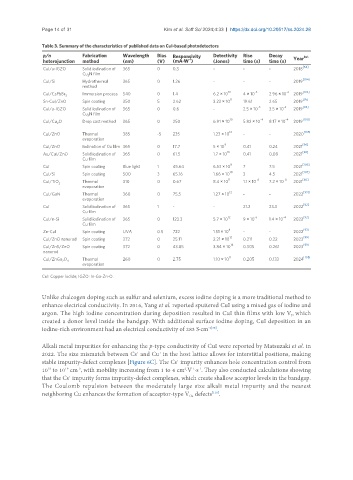
               Table 3. Summary of the characteristics of published data on CuI-based photodetectors
                p/n          Fabrication   Wavelength   Bias   Responsivity   Detectivity  Rise   Decay   Year Ref.
                                                                 -1
                heterojunction  method    (nm)        (V)  (mA·W )       (Jones)   time (s)  time (s)
                                                                                                       [64]
                CuI/a-IGZO   Solid iodination of   365  0  0.3           -         -        -       2018
                             Cu N film
                               3
                                                                                                       [104]
                CuI/Si       Hydrothermal   365       0    1.26          -         -        -       2019
                             method
                                                                              10       -5         -2   [103]
                CuI/CsPbBr   Immersion process  540   0    1.4           6.2 × 10  4 × 10   2.96 × 10  2019
                       3
                                                                               11                      [95]
                Sn-CuI/ZnO   Spin coating  350        5    2.62          3.23 × 10  19.61   2.65    2019
                CuI/a-IGZO   Solid iodination of   365  0  0.6           -         2.5 × 10 -3  3.5 × 10 -2  2019 [94]
                             Cu N film
                               3
                CuI/Cu O     Drop cast method  365    0    250           6.91 × 10 10  5.82 × 10 -4  8.17 × 10 -4  2019 [100]
                    2
                                                                              12                       [105]
                CuI/ZnO      Thermal      385         -5   235           1.23 × 10  -       -       2020
                             evaporation
                                                                             9                         [96]
                CuI/ZnO      Iodination of Cu film 365  0  17.7          5 × 10    0.41     0.24    2021
                Au/CuI/ZnO   Solid iodination of   365  0  61.5          1.7 × 10 10  0.41  0.08    2021 [96]
                             Cu film
                CuI          Spin coating  Blue light  1   45.64         6.53 × 10 9  7     7.5     2021 [106]
                                                                              10                       [107]
                CuI/Si       Spin coating  500        3    65.16         1.66 × 10  3       4.5     2021
                                                                              11       -4        -4    [60]
                CuI/TiO 2    Thermal      310         0    0.67          8.4 × 10  1.1 × 10  7.2 × 10  2021
                             evaporation
                                                                              12                       [101]
                CuI/GaN      Thermal      360         0    75.5          1.27 × 10  -       -       2022
                             evaporation
                                                                                                       [92]
                CuI          Solid iodination of   365  1  -             -         21.2     23.3    2022
                             Cu film
                                                                              12       -5       -4     [92]
                CuI/n-Si     Solid iodination of   365  0  123.3         5.7 × 10  9 × 10   1.4 × 10  2022
                             Cu film
                                                                              8                        [93]
                Zn-CuI       Spin coating  UVA        0.5  722           1.51 × 10  -       -       2022
                                                                              12                       [99]
                CuI/ZnO nanorod  Spin coating  372    0    25.11         2.21 × 10  0.211   0.22    2023
                CuI/ZnS/ZnO   Spin coating  372       0    43.85         3.84 × 10 14  0.305  0.261  2023 [99]
                nanorod
                CuI/ZnGa O 4  Thermal     260         0    2.75          1.10 × 10 11  0.205  0.133  2024 [108]
                      2
                             evaporation
               CuI: Copper iodide; IGZO: In-Ga-Zn-O.
               Unlike chalcogen doping such as sulfur and selenium, excess iodine doping is a more traditional method to
               enhance electrical conductivity. In 2016, Yang et al. reported sputtered CuI using a mixed gas of iodine and
               argon. The high iodine concentration during deposition resulted in CuI thin films with low V , which
                                                                                                   I
               created a donor level inside the bandgap. With additional surface iodine doping, CuI deposition in an
               iodine-rich environment had an electrical conductivity of 283 S·cm -1[38] .


               Alkali metal impurities for enhancing the p-type conductivity of CuI were reported by Matsuzaki et al. in
               2022. The size mismatch between Cs  and Cu  in the host lattice allows for interstitial positions, making
                                                       +
                                               +
                                                             +
               stable impurity-defect complexes [Figure 6C]. The Cs  impurity enhances hole concentration control from
               10  to 10  cm , with mobility increasing from 1 to 4 cm ·V ·s . They also conducted calculations showing
                           -3
                                                               2
                 13
                       19
                                                                  -1 -1
               that the Cs  impurity forms impurity-defect complexes, which create shallow acceptor levels in the bandgap.
                        +
               The Coulomb repulsion between the moderately large size alkali metal impurity and the nearest
               neighboring Cu enhances the formation of acceptor-type V  defects .
                                                                        [110]
                                                                 Cu

