


Page 87 - Read Online
P. 87
Kim et al. Soft Sci 2024;4:32  https://dx.doi.org/10.20517/ss.2024.28           Page 11 of 31

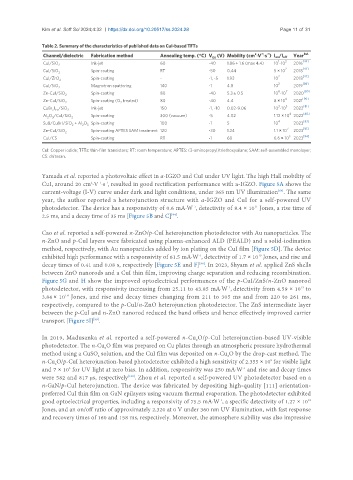
               Table 2. Summary of the characteristics of published data on CuI-based TFTs
                                                                                           -1
                                                                                         -1
                                                                                       2
                Channel/dielectric  Fabrication method  Annealing temp. (°C) V  (V) Mobility (cm ·V ·s ) I on /I off    Year Ref.
                                                                         DS
                                                                                               1
                CuI/SiO 2       Ink-jet                60              -40    1.86 ± 1.6 (max 4.4)  10 -10 2  2016 [44]
                                                                                                 2     [42]
                CuI/SiO         Spin-coating           RT              -50    0.44           5 × 10  2018
                     2
                                                                                               2       [42]
                CuI/ZrO         Spin-coating           -               -1, -5  1.93          10     2018
                     2
                CuI/SiO 2       Magnetron sputtering   140             -1     4.8            10 2   2019 [89]
                                                                                               6  7    [80]
                Zn-CuI/SiO      Spin-coating           80              -40    5.3 ± 0.5      10 -10  2020
                       2
                Zn-CuI/SiO 2    Spin-coating (O  treated)  80          -40    4.4            8 × 10 6  2021 [90]
                                          2
                                                                                               3  5    [81]
                CuBr I /SiO     Ink-jet                150             -1, -10  0.02-9.06    10 -10  2022
                   x 1-x  2
                                                                                                   4   [40]
                Al O /CuI/SiO 2  Spin-coating          300 (vacuum)    -5     4.02           1.12 × 10 2022
                   3
                 2
                Su8/CuBrI/SiO  + Al O Spin-coating     100             -1     5              10 4   2023 [83]
                         2
                              3
                             2
                                                                                                  7    [91]
                Zn-CuI/SiO      Spin-coating APTES SAM treatment 120   -30    1.24           1.1 × 10  2023
                       2
                CuI/CS          Spin-coating           RT              -1     60             6.6 × 10 3  2023 [84]
               CuI: Copper iodide; TFTs: thin-film transistors; RT: room temperature; APTES: (3-aminopropyl)triethoxysilane; SAM: self-assembled monolayer;
               CS: chitosan.
               Yamada et al. reported a photovoltaic effect in a-IGZO and CuI under UV light. The high Hall mobility of
               CuI, around 20 cm ·V ·s , resulted in good rectification performance with a-IGZO. Figure 5A shows the
                                  -1 -1
                                2
               current-voltage (I-V) curve under dark and light conditions, under 365 nm UV illumination . The same
                                                                                               [64]
               year, the author reported a heterojunction structure with a-IGZO and CuI for a self-powered UV
                                                                                       11
                                                                  -1
               photodetector. The device has a responsivity of 0.6 mA·W , detectivity of 8.4 × 10  Jones, a rise time of
                                                           [94]
               2.5 ms, and a decay time of 35 ms [Figure 5B and C] .
               Cao et al. reported a self-powered n-ZnO/p-CuI heterojunction photodetector with Au nanoparticles. The
               n-ZnO and p-CuI layers were fabricated using plasma-enhanced ALD (PEALD) and a solid-iodination
               method, respectively, with Au nanoparticles added by ion plating on the CuI film [Figure 5D]. The device
                                                                    -1
                                                                                        10
               exhibited high performance with a responsivity of 61.5 mA·W , detectivity of 1.7 × 10  Jones, and rise and
               decay times of 0.41 and 0.08 s, respectively [Figure 5E and F] . In 2023, Shyam et al. applied ZnS shells
                                                                    [96]
               between ZnO nanorods and a CuI thin film, improving charge separation and reducing recombination.
               Figure 5G and H show the improved optoelectrical performances of the p-CuI/ZnS/n-ZnO nanorod
               photodetector, with responsivity increasing from 25.11 to 43.85 mA·W , detectivity from 4.59 × 10  to
                                                                                                      13
                                                                              -1
               3.84 × 10  Jones, and rise and decay times changing from 211 to 305 ms and from 220 to 261 ms,
                       14
               respectively, compared to the p-CuI/n-ZnO heterojunction photodetector. The ZnS intermediate layer
               between the p-CuI and n-ZnO nanorod reduced the band offsets and hence effectively improved carrier
               transport [Figure 5I] .
                                [99]
               In 2019, Madusanka et al. reported a self-powered n-Cu O/p-CuI heterojunction-based UV-visible
                                                                   2
               photodetector. The n-Cu O film was prepared on Cu plates through an atmospheric pressure hydrothermal
                                    2
               method using a CuSO  solution, and the CuI film was deposited on n-Cu O by the drop-cast method. The
                                  4
                                                                              2
               n-Cu O/p-CuI heterojunction-based photodetector exhibited a high sensitivity of 2.355 × 10  for visible light
                                                                                            5
                    2
               and 7 × 10  for UV light at zero bias. In addition, responsivity was 250 mA·W  and rise and decay times
                                                                                   -1
                        3
               were 582 and 817 μs, respectively . Zhou et al. reported a self-powered UV photodetector based on a
                                            [100]
               n-GaN/p-CuI heterojunction. The device was fabricated by depositing high-quality [111] orientation-
               preferred CuI thin film on GaN epilayers using vacuum thermal evaporation. The photodetector exhibited
               good optoelectrical properties, including a responsivity of 75.5 mA·W , a specific detectivity of 1.27 × 10
                                                                           -1
                                                                                                         12
               Jones, and an on/off ratio of approximately 2,320 at 0 V under 360 nm UV illumination, with fast response
               and recovery times of 160 and 158 ms, respectively. Moreover, the atmosphere stability was also impressive

