


Page 84 - Read Online
P. 84
Page 8 of 31                             Kim et al. Soft Sci 2024;4:33  https://dx.doi.org/10.20517/ss.2024.28

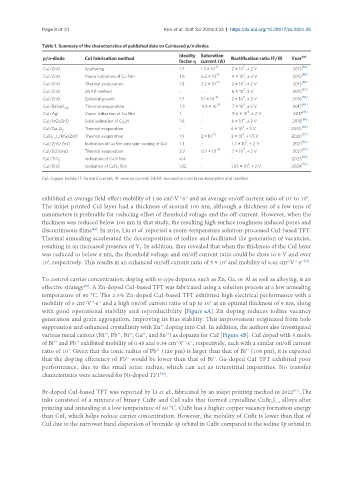
               Table 1. Summary of the characteristics of published data on CuI-based p/n diodes
                                                             Ideality  Saturation                      Ref.
                p/n-diode     CuI fabrication method                           Rectification ratio IF/IR  Year
                                                             factor η current (A)
                                                                          -11      7                   [66]
                CuI/ZnO       Sputtering                     1.7     1.3 × 10  2 × 10 , ± 2 V       2013
                                                                          -15      7                   [66]
                CuI/ZnO       Vapor iodization of Cu film     1.6    6.2 × 10  4 × 10 , ± 2 V       2013
                                                                                   7
                CuI/ZnO       Thermal evaporation            1.8     3.2 × 10 -13  2 × 10 , ± 2 V   2013 [66]
                                                                                   2                   [67]
                CuI/ZnO       SILAR method                    -      -         6 × 10 , 3 V         2015
                                                                                   9
                CuI/ZnO       Epitaxial growth               1.7     1.1 × 10 -12  2 × 10 , ± 2 V   2016 [59]
                                                                                   5
                CuI/BaSnO 3-δ   Thermal evaporation           1.5    9.9 × 10 -13  7 × 10 , ± 2 V   2017 [63]
                                                                                    4
                CuI/AgI       Vapor iodization of Cu film     1      -         9.4 × 10 , ± 2 V     2017 [61]
                                                                                   6                   [64]
                CuI/InGaZnO   Solid iodination of Cu N        1.6    -         6 × 10 , ± 2 V       2018
                                           3
                                                                                   3                   [68]
                CuI/Ga O 3    Thermal evaporation            -       -         6 × 10 , ± 2 V      2020
                    2
                                                                                   9
                CuBr I /InGaZnO  Thermal evaporation         1.9     2 × 10 -12  2 × 10 , ± 1.5 V  2020 [57]
                   1-x x
                                                                                    7                  [62]
                CuI/ZnS/ZnO   Iodination of Cu film and spin-coating of CuI  1.1  -  1.7 × 10 , ± 2 V  2021
                                                                          -16      7                   [65]
                CuI/SiZnSnO   Thermal evaporation             2.7    0.7 × 10  7 × 10 , ± 2 V       2021
                CuI/TiO 2     Iodination of CuO film         4.4     -         -                   2023 [69]
                                                                                     5                 [70]
                CuI/ZnO       Iodination of CuN  film        1.22    -         1.05 × 10 , ± 2 V   2024
                                         3
               CuI: Copper iodide; IF: forward current; IR: reverse current; SILAR: successive ionic layer absorption and reaction.
               exhibited an average field-effect mobility of 1.86 cm ·V ·s  and an average on/off current ratio of 10  to 10 .
                                                                                                        2
                                                           2
                                                             -1 -1
                                                                                                   1
               The inkjet printed CuI layer had a thickness of around 100 nm, although a thickness of a few tens of
               nanometers is preferable for reducing offset of threshold voltage and the off-current. However, when the
               thickness was reduced below 100 nm in that study, the resulting high surface roughness induced pores and
               discontinuous films . In 2018, Liu et al. reported a room-temperature solution-processed CuI-based TFT.
                                [44]
               Thermal annealing accelerated the decomposition of iodine and facilitated the generation of vacancies,
               resulting in an increased presence of V . In addition, they revealed that when the thickness of the CuI layer
                                                I
               was reduced to below 8 nm, the threshold voltage and on/off current ratio could be close to 0 V and over
                                                                             2
               10 , respectively. This results in an enhanced on/off current ratio of 5 × 10  and mobility of 0.44 cm ·V ·s  .
                 2
                                                                                                    -1 -1[42]
                                                                                                  2
               To control carrier concentration, doping with n-type dopants, such as Zn, Ga, or Al as well as alloying, is an
                             [80]
               effective strategy . A Zn-doped CuI-based TFT was fabricated using a solution process at a low annealing
               temperature of 80 °C. The 2.5% Zn-doped CuI-based TFT exhibited high electrical performance with a
                             2
                                                                        7
                                -1 -1
               mobility of 5 cm ·V ·s  and a high on/off current ratio of up to 10  at an optimal thickness of 9 nm, along
               with good operational stability and reproducibility [Figure 4A]. Zn doping reduces iodine vacancy
               generation and grain aggregation, improving its bias stability. This improvement originated from hole
               suppression and enhanced crystallinity with Zn  doping into CuI. In addition, the authors also investigated
                                                       2+
               various metal cations (Ni , Pb , Bi , Ga , and Sn ) as dopants for CuI [Figure 4B]. CuI doped with 5 mol%
                                         2+
                                    2+
                                             3+
                                                         4+
                                                 3+
                           2+
                   3+
               of Bi  and Pb  exhibited mobility of 0.45 and 0.34 cm ·V ·s , respectively, each with a similar on/off current
                                                            2
                                                               -1 -1
               ratio of 10 . Given that the ionic radius of Pb  (120 pm) is larger than that of Bi  (108 pm), it is expected
                                                      2+
                        4
                                                                                    3+
               that the doping efficiency of Pb  would be lower than that of Bi . Ga-doped CuI TFT exhibited poor
                                                                         3+
                                           2+
               performance, due to the small ionic radius, which can act as interstitial impurities. No transfer
               characteristics were achieved for Ni-doped TFT .
                                                       [80]
                                                                                                    [81]
               Br-doped CuI-based TFT was reported by Li et al., fabricated by an inkjet printing method in 2022 . The
               inks consisted of a mixture of binary CuBr and CuI salts that formed crystalline CuBr I  alloys after
                                                                                            x 1-x
               printing and annealing at a low temperature of 60 °C. CuBr has a higher copper vacancy formation energy
               than CuI, which helps reduce carrier concentration. However, the mobility of CuBr is lower than that of
               CuI due to the narrower band dispersion of bromide 4p orbital in CuBr compared to the iodine 5p orbital in

