


Page 81 - Read Online
P. 81
Kim et al. Soft Sci 2024;4:33  https://dx.doi.org/10.20517/ss.2024.28            Page 5 of 31


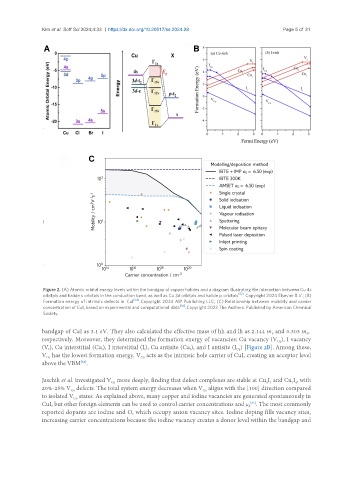
                Figure 2. (A) Atomic orbital energy levels within the bandgap of copper halides and a diagram illustrating the interaction between Cu 4s
                orbitals and halide s orbitals in the conduction band, as well as Cu 3d orbitals and halide p orbitals [52] . Copyright 2024 Elsevier B.V.; (B)
                Formation energy of intrinsic defects in  CuI [54] . Copyright 2024 AIP Publishing LLC; (C) Relationship between mobility and carrier
                concentration of CuI, based on experimental and computational data [14] . Copyright 2023 The Authors. Published by American Chemical
                Society.

               bandgap of CuI as 3.1 eV. They also calculated the effective mass of hh and lh as 2.144 m  and 0.303 m ,
                                                                                             0
                                                                                                        0
               respectively. Moreover, they determined the formation energy of vacancies: Cu vacancy (V ), I vacancy
                                                                                              Cu
               (V ), Cu interstitial (Cu), I interstitial (I), Cu antisite (Cu ), and I antisite (I ) [Figure 2B]. Among these,
                 I
                                   i
                                                                 I
                                                                                 Cu
                                                  i
               V  has the lowest formation energy. V  acts as the intrinsic hole carrier of CuI, creating an acceptor level
                                                Cu
                 Cu
               above the VBM .
                            [54]
               Jaschik et al. investigated V  more deeply, finding that defect complexes are stable at Cu I  and Cu I , with
                                                                                           4 5
                                                                                                   3 4
                                      Cu
               20%-25% V  defects. The total system energy decreases when V  aligns with the [100] direction compared
                                                                     Cu
                         Cu
               to isolated V  states. As explained above, many copper and iodine vacancies are generated spontaneously in
                          Cu
               CuI, but other foreign elements can be used to control carrier concentrations and μ . The most commonly
                                                                                     [55]
                                                                                     h
               reported dopants are iodine and O, which occupy anion vacancy sites. Iodine doping fills vacancy sites,
               increasing carrier concentrations because the iodine vacancy creates a donor level within the bandgap and

