


Page 80 - Read Online
P. 80
Page 4 of 31                             Kim et al. Soft Sci 2024;4:33  https://dx.doi.org/10.20517/ss.2024.28


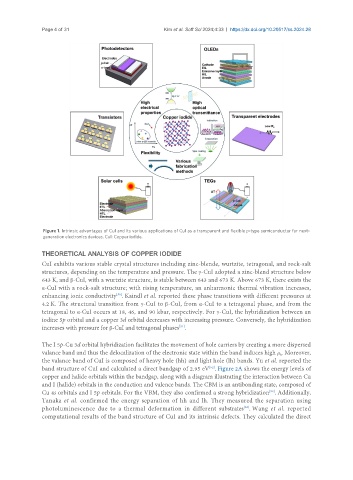
                Figure 1. Intrinsic advantages of CuI and its various applications of CuI as a transparent and flexible p-type semiconductor for next-
                generation electronics devices. CuI: Copper iodide.


               THEORETICAL ANALYSIS OF COPPER IODIDE
               CuI exhibits various stable crystal structures including zinc-blende, wurtzite, tetragonal, and rock-salt
               structures, depending on the temperature and pressure. The γ-CuI adopted a zinc-blend structure below
               643 K, and β-CuI, with a wurtzite structure, is stable between 643 and 673 K. Above 673 K, there exists the
               α-CuI with a rock-salt structure; with rising temperature, an anharmonic thermal vibration increases,
               enhancing ionic conductivity . Kaindl et al. reported these phase transitions with different pressures at
                                        [50]
               4.2 K. The structural transition from γ-CuI to β-CuI, from α-CuI to a tetragonal phase, and from the
               tetragonal to α-CuI occurs at 18, 46, and 90 kbar, respectively. For γ-CuI, the hybridization between an
               iodine 5p orbital and a copper 3d orbital decreases with increasing pressure. Conversely, the hybridization
                                                             [51]
               increases with pressure for β-CuI and tetragonal phases .

               The I 5p-Cu 3d orbital hybridization facilitates the movement of hole carriers by creating a more dispersed
               valance band and thus the delocalization of the electronic state within the band induces high μ . Moreover,
                                                                                               h
               the valance band of CuI is composed of heavy hole (hh) and light hole (lh) bands. Yu et al. reported the
                                                                        [52]
               band structure of CuI and calculated a direct bandgap of 2.95 eV . Figure 2A shows the energy levels of
               copper and halide orbitals within the bandgap, along with a diagram illustrating the interaction between Cu
               and I (halide) orbitals in the conduction and valence bands. The CBM is an antibonding state, composed of
               Cu 4s orbitals and I 5p orbitals. For the VBM, they also confirmed a strong hybridization . Additionally,
                                                                                            [52]
               Tanaka et al. confirmed the energy separation of hh and lh. They measured the separation using
                                                                                   [53]
               photoluminescence due to a thermal deformation in different  substrates . Wang et al. reported
               computational results of the band structure of CuI and its intrinsic defects. They calculated the direct

