


Page 69 - Read Online
P. 69
Wu et al. Soft Sci 2024;4:29  https://dx.doi.org/10.20517/ss.2024.21            Page 15 of 22


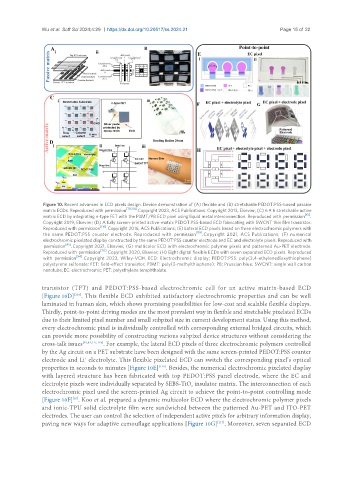
                Figure 10. Recent advances in ECD pixels design. Device demonstration of (A) flexible and (B) stretchable PEDOT:PSS-based passive
                matrix ECDs. Reproduced with permission [113,114] .Copyright 2023, ACS Publications. Copyright 2013, Elsevier; (C) 6 × 6 stretchable active
                matrix ECD by integrating n-type FET with the P3MT/PB ECD pixel using liquid metal interconnection. Reproduced with permission [61] .
                Copyright 2019, Elsevier; (D) A fully screen-printed active-matrix PEDOT:PSS-based ECD fabricating with SWCNT thin film transistor.
                Reproduced with permission [116] . Copyright 2016, ACS Publications; (E) Lateral ECD pixels based on three electrochromic polymers with
                the  same  PEDOT:PSS  counter  electrode.  Reproduced  with  permission [119] . Copyright  2021,  ACS  Publications;  (F)  numerical
                electrochromic pixelated display constructed by the same PEDOT:PSS counter electrode and EC and electrolyte pixels. Reproduced with
                permission [65] . Copyright 2021, Elsevier; (G) multicolor ECD with electrochromic polymer pixels and patterned Au-PET electrode.
                Reproduced with permission [117] . Copyright 2020, Elsevier; (H) Eight digital flexible ECDs with seven separated ECD pixels. Reproduced
                with  permission [84] . Copyright 2023, Wiley-VCH. ECD: Electrochromic display; PEDOT:PSS: poly(3,4-ethylenedioxythiophene)
                polystyrene sulfonate; FET: field-effect transistor; P3MT: poly(3-methylthiophene); PB: Prussian blue; SWCNT: single wall carbon
                nanotube; EC: electrochromic; PET: polyethylene terephthalate.


               transistor  (TFT)  and  PEDOT:PSS-based  electrochromic  cell  for  an  active  matrix-based  ECD
               [Figure 10D] . This flexible ECD exhibited satisfactory electrochromic properties and can be well
                          [116]
               laminated in human skin, which shows promising possibilities for low-cost and scalable flexible displays.
               Thirdly, point-to-point driving modes are the most prevalent way in flexible and stretchable pixelated ECDs
               due to their limited pixel number and small subpixel size in current development status. Using this method,
               every electrochromic pixel is individually controlled with corresponding external bridged circuits, which
               can provide more possibility of constructing various subpixel device structures without considering the
               cross-talk issues [49,84,117,118] . For example, the lateral ECD pixels of three electrochromic polymers controlled
               by the Ag circuit on a PET substrate have been designed with the same screen-printed PEDOT:PSS counter
                              +
               electrode and Li  electrolyte. This flexible pixelated ECD can switch the corresponding pixel’s optical
               properties in seconds to minutes [Figure 10E] . Besides, the numerical electrochromic pixelated display
                                                       [119]
               with layered structure has been fabricated with top PEDOT:PSS panel electrode, where the EC and
               electrolyte pixels were individually separated by SEBS-TiO  insulator matrix. The interconnection of each
                                                                 2
               electrochromic pixel used the screen-printed Ag circuit to achieve the point-to-point controlling mode
               [Figure 10F] . Koo et al. prepared a dynamic multicolor ECD where the electrochromic polymer pixels
                          [65]
               and ionic-TPU solid electrolyte film were sandwiched between the patterned Au-PET and ITO-PET
               electrodes. The user can control the selection of independent active pixels for arbitrary information display,
                                                                          [117]
               paving new ways for adaptive camouflage applications [Figure 10G] . Moreover, seven separated ECD

