


Page 66 - Read Online
P. 66
Page 12 of 22                             Wu et al. Soft Sci 2024;4:29  https://dx.doi.org/10.20517/ss.2024.21


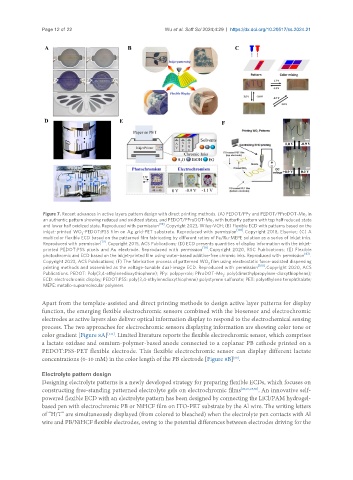
                Figure 7. Recent advances in active layers pattern design with direct printing methods. (A) PEDOT/PPy and PEDOT/PProDOT-Me  in
                                                                                                        2
                an authentic pattern showing reduced and oxidized states, and PEDOT/PProDOT-Me  with butterfly pattern with top half reduced state
                                                                         2
                and lower half oxidized state. Reproduced with permission [99] . Copyright 2023, Wiley-VCH; (B) Flexible ECD with patterns based on the
                inkjet-printed WO -PEDOT:PSS film on Ag grid-PET substrate. Reproduced with  permission [103] . Copyright 2018, Elsevier; (C) A
                             3
                multicolor flexible ECD based on the patterned film fabricating by different ratios of Fe/Ru-MEPE solution as a series of inkjet inks.
                Reproduced with permission [22] . Copyright 2015, ACS Publications; (D) ECD presents quantities of display information with the inkjet-
                printed PEDOT:PSS pixels and Au electrode. Reproduced with  permission [79] . Copyright 2020, RSC Publications; (E) Flexible
                photochromic and ECD based on the inkjet-printed film using water-based additive-free chromic inks. Reproduced with permission [63] .
                Copyright 2023, ACS Publications; (F) The fabrication process of patterned WO  film using electrostatic force-assisted dispensing
                                                                       3
                printing methods and assembled as the voltage-tunable dual-image ECD. Reproduced with  permission [109] . Copyright 2020, ACS
                Publications. PEDOT: Poly(3,4-ethylenedioxythiophene); PPy: polypyrrole; PProDOT-Me : poly(dimethylpropylene-dioxythiophene);
                                                                            2
                ECD: electrochromic display; PEDOT:PSS: poly(3,4-ethylenedioxythiophene) polystyrene sulfonate; PET: polyethylene terephthalate;
                MEPE: metallo-supramolecular polymers.
               Apart from the template-assisted and direct printing methods to design active layer patterns for display
               function, the emerging flexible electrochromic sensors combined with the biosensor and electrochromic
               electrodes as active layers also deliver optical information display to respond to the electrochemical sensing
               process. The two approaches for electrochromic sensors displaying information are showing color tone or
                                     [111]
               color gradient [Figure 8A] . Limited literature reports the flexible electrochromic sensor, which comprises
               a lactate oxidase and osmium-polymer-based anode connected to a coplanar PB cathode printed on a
               PEDOT:PSS-PET flexible electrode. This flexible electrochromic sensor can display different lactate
                                                                                [60]
               concentrations (0-10 mM) in the color length of the PB electrode [Figure 8B] .
               Electrolyte pattern design
               Designing electrolyte patterns is a newly developed strategy for preparing flexible ECDs, which focuses on
               constructing free-standing patterned electrolyte gels on electrochromic films [20,21,25,50] . An innovative self-
               powered flexible ECD with an electrolyte pattern has been designed by connecting the LiCl/PAM hydrogel-
               based pen with electrochromic PB or NiHCF film on ITO-PET substrate by the Al wire. The writing letters
               of “H/T” are simultaneously displayed (from colored to bleached) when the electrolyte pen contacts with Al
               wire and PB/NiHCF flexible electrodes, owing to the potential differences between electrodes driving for the

