


Page 64 - Read Online
P. 64
Page 10 of 22                             Wu et al. Soft Sci 2024;4:29  https://dx.doi.org/10.20517/ss.2024.21


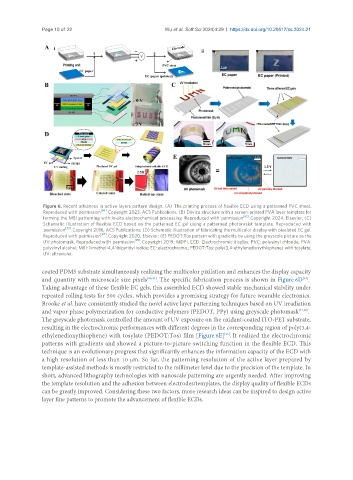
                Figure 6. Recent advances in active layers pattern design. (A) The printing process of flexible ECD using a patterned PVC sheet.
                Reproduced with permission [66] . Copyright 2023, ACS Publications; (B) Device structure with a screen-printed PVA layer template for
                forming the MBI patterning with in-situ electrochemical processing. Reproduced with  permission [62] . Copyright 2024, Elsevier; (C)
                Schematic illustration of flexible ECD based on the patterned EC gel using a patterned photoresist template. Reproduced with
                permission [73] . Copyright 2016, ACS Publications; (D) Schematic illustration of fabricating the multicolor display with pixelated EC gel.
                Reproduced with permission [94] . Copyright 2020, Elsevier; (E) PEDOT:Tos pattern with gradients by using the greyscale picture as the
                UV photomask. Reproduced with  permission [95] . Copyright 2019, MDPI. ECD: Electrochromic display; PVC: polyvinyl chloride; PVA:
                polyvinyl alcohol; MBI: 1-methyl-4,4’-bipyridyl iodide; EC: electrochromic; PEDOT:Tos: poly(3,4-ethylenedioxythiophene) with tosylate;
                UV: ultraviolet.

               coated PDMS substrate simultaneously realizing the multicolor pixilation and enhances the display capacity
                                                                                                       [94]
               and quantity with microscale size pixels [86,94] . The specific fabrication process is shown in Figure 6D .
               Taking advantage of these flexible EC gels, this assembled ECD showed stable mechanical stability under
               repeated rolling tests for 500 cycles, which provides a promising strategy for future wearable electronics.
               Brooke et al. have consistently studied the novel active layer patterning techniques based on UV irradiation
               and vapor phase polymerization for conductive polymers (PEDOT, PPy) using greyscale photomask [71,95] .
               The greyscale photomask controlled the amount of UV exposure on the oxidant-coated ITO-PET substrate,
               resulting in the electrochromic performances with different degrees in the corresponding region of poly(3,4-
               ethylenedioxythiophene) with tosylate (PEDOT:Tos) film [Figure 6E] . It realized the electrochromic
                                                                             [95]
               patterns with gradients and showed a picture-to-picture switching function in the flexible ECD. This
               technique is an evolutionary progress that significantly enhances the information capacity of the ECD with
               a high resolution of less than 10 μm. So far, the patterning resolution of the active layer prepared by
               template-assisted methods is mostly restricted to the millimeter level due to the precision of the template. In
               short, advanced lithography technologies with nanoscale patterning are urgently needed. After improving
               the template resolution and the adhesion between electrodes/templates, the display quality of flexible ECDs
               can be greatly improved. Considering these two factors, more research ideas can be inspired to design active
               layer fine patterns to promote the advancement of flexible ECDs.

