


Page 60 - Read Online
P. 60
Page 6 of 22                              Wu et al. Soft Sci 2024;4:29  https://dx.doi.org/10.20517/ss.2024.21


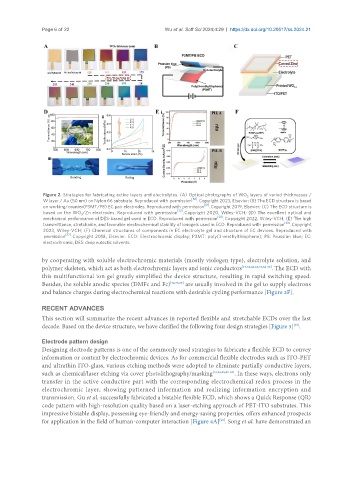
                Figure 2. Strategies for fabricating active layers and electrolytes. (A) Optical photographs of WO  layers of varied thicknesses /
                                                                                    3
                                                                  [68]
                W layer / Au (50 nm) on Nylon 66 substrate. Reproduced with permission  . Copyright 2023, Elsevier; (B) The ECD structure is based
                                                                      [61]
                on working/counter(P3MT/PB) EC pair electrodes. Reproduced with permission  . Copyright 2019, Elsevier; (C) The ECD structure is
                                                             [72]
                based on the WO /Zn electrodes. Reproduced with  permission  . Copyright 2020, Wiley-VCH; (D) The excellent optical and
                            3
                                                                          [20]
                mechanical performance of DES-based gel used in ECD. Reproduced with  permission  . Copyright 2022, Wiley-VCH; (E) The high
                transmittance, stretchable, and favorable electrochemical stability of ionogels used in ECD. Reproduced with permission [83] . Copyright
                2023, Wiley-VCH; (F) Chemical structures of components in EC electrolyte gel and structure of EC devices. Reproduced with
                permission [32] . Copyright 2018, Elsevier. ECD: Electrochromic display; P3MT: poly(3-methylthiophene); PB: Prussian blue; EC:
                electrochromic; DES: deep eutectic solvents.
               by cooperating with soluble electrochromic materials (mostly viologen type), electrolyte solution, and
               polymer skeleton, which act as both electrochromic layers and ionic conductors [19,32,44,62,73,84-86] . The ECD with
               this multifunctional ion gel greatly simplified the device structure, resulting in rapid switching speed.
               Besides, the soluble anodic species (DMFc and Fc) [32,73,86]  are usually involved in the gel to supply electrons
               and balance charges during electrochemical reactions with desirable cycling performance [Figure 2F].

               RECENT ADVANCES
               This section will summarize the recent advances in reported flexible and stretchable ECDs over the last
               decade. Based on the device structure, we have clarified the following four design strategies [Figure 3] .
                                                                                                    [87]
               Electrode pattern design
               Designing electrode patterns is one of the commonly used strategies to fabricate a flexible ECD to convey
               information or content by electrochromic devices. As for commercial flexible electrodes such as ITO-PET
               and ultrathin ITO-glass, various etching methods were adopted to eliminate partially conductive layers,
               such as chemical/laser etching via cover photolithography/masking [19,83,85,88-90] . In these ways, electrons only
               transfer in the active conductive part with the corresponding electrochemical redox process in the
               electrochromic layer, showing patterned information and realizing information encryption and
               transmission. Gu et al. successfully fabricated a bistable flexible ECD, which shows a Quick Response (QR)
               code pattern with high-resolution quality based on a laser-etching approach of PET-ITO substrates. This
               impressive bistable display, possessing eye-friendly and energy-saving properties, offers enhanced prospects
               for application in the field of human-computer interaction [Figure 4A] . Song et al. have demonstrated an
                                                                           [90]

