


Page 57 - Read Online
P. 57
Wu et al. Soft Sci 2024;4:29  https://dx.doi.org/10.20517/ss.2024.21             Page 3 of 22

                                                                      [31]
               metal grid (Au/Ag/Ni grid) [28-30]  and metal mesh (Ni/Ag mesh) . The inherent structural properties of
               metal nanowires (NWs)/mesh/grid and polymer confer the robust mechanical stability of these electrodes.
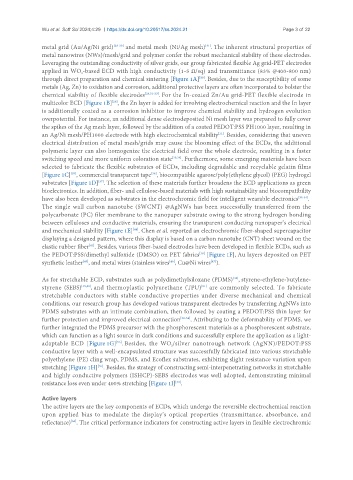
               Leveraging the outstanding conductivity of silver grids, our group fabricated flexible Ag grid-PET electrodes
               applied in WO -based ECD with high conductivity (1-5 Ω/sq) and transmittance (83% @400-800 nm)
                            3
               through direct preparation and chemical sintering [Figure 1A] . Besides, due to the susceptibility of some
                                                                    [30]
               metals (Ag, Zn) to oxidation and corrosion, additional protective layers are often incorporated to bolster the
               chemical stability of flexible electrodes [28,31-33] . For the In-coated Zn/Au grid-PET flexible electrode in
                                       [28]
               multicolor ECD [Figure 1B] , the Zn layer is added for involving electrochemical reaction and the In layer
               is additionally coated as a corrosion inhibitor to improve chemical stability and hydrogen evolution
               overpotential. For instance, an additional dense electrodeposited Ni mesh layer was prepared to fully cover
               the spikes of the Ag mesh layer, followed by the addition of a coated PEDOT:PSS PH1000 layer, resulting in
               an Ag/Ni mesh/PH1000 electrode with high electrochemical stability . Besides, considering that uneven
                                                                           [31]
               electrical distribution of metal mesh/grids may cause the blooming effect of the ECDs, the additional
               polymeric layer can also homogenize the electrical field over the whole electrode, resulting in a faster
               switching speed and more uniform coloration state [29,34] . Furthermore, some emerging materials have been
               selected to fabricate the flexible substrates of ECDs, including degradable and recyclable gelatin films
                                                    [36]
                         [35]
               [Figure 1C] , commercial transparent tape , biocompatible agarose/poly(ethylene glycol) (PEG) hydrogel
               substrates [Figure 1D] . The selection of these materials further broadens the ECD applications as green
                                  [37]
               bioelectronics. In addition, fiber- and cellulose-based materials with high sustainability and biocompatibility
               have also been developed as substrates in the electrochromic field for intelligent wearable electronics [38-44] .
               The single wall carbon nanotube (SWCNT) @AgNWs has been successfully transferred from the
               polycarbonate (PC) filer membrane to the nanopaper substrate owing to the strong hydrogen bonding
               between celluloses and conductive materials, ensuring the transparent conducting nanopaper’s electrical
                                              [44]
               and mechanical stability [Figure 1E] . Chen et al. reported an electrochromic fiber-shaped supercapacitor
               displaying a designed pattern, where this display is based on a carbon nanotube (CNT) sheet wound on the
               elastic rubber fiber . Besides, various fiber-based electrodes have been developed in flexible ECDs, such as
                               [43]
               the PEDOT:PSS/dimethyl sulfoxide (DMSO) on PET fabrics  [Figure 1F], Au layers deposited on PET
                                                                    [38]
               synthetic leather , and metal wires (stainless wires , Cu@Ni wires ).
                             [45]
                                                                        [47]
                                                          [46]
                                                                                [48]
               As for stretchable ECD, substrates such as polydimethylsiloxane (PDMS) , styrene-ethylene-butylene-
               styrene (SEBS) [49,50] , and thermoplastic polyurethane (TPU)  are commonly selected. To fabricate
                                                                     [51]
               stretchable conductors with stable conductive properties under diverse mechanical and chemical
               conditions, our research group has developed various transparent electrodes by transferring AgNWs into
               PDMS substrates with an intimate combination, then followed by coating a PEDOT:PSS thin layer for
               further protection and improved electrical connection [52-54] . Attributing to the deformability of PDMS, we
               further integrated the PDMS precursor with the phosphorescent materials as a phosphorescent substrate,
               which can function as a light source in dark conditions and successfully explore the application as a light-
               adaptable  ECD  [Figure 1G] . Besides,  the  WO /silver  nanotrough  network  (AgNN)/PEDOT:PSS
                                        [53]
                                                           3
               conductive layer with a well-encapsulated structure was successfully fabricated into various stretchable
               polyethylene (PE) cling wrap, PDMS, and Ecoflex substrates, exhibiting slight resistance variation upon
               stretching [Figure 1H] . Besides, the strategy of constructing semi-interpenetrating networks in stretchable
                                  [55]
               and highly conductive polymers (ISHCP)-SEBS electrodes was well adopted, demonstrating minimal
               resistance loss even under 400% stretching [Figure 1I] .
                                                            [50]
               Active layers
               The active layers are the key components of ECDs, which undergo the reversible electrochemical reaction
               upon applied bias to modulate the display’s optical properties (transmittance, absorbance, and
                         [56]
               reflectance) . The critical performance indicators for constructing active layers in flexible electrochromic

