


Page 58 - Read Online
P. 58
Page 4 of 22                              Wu et al. Soft Sci 2024;4:29  https://dx.doi.org/10.20517/ss.2024.21


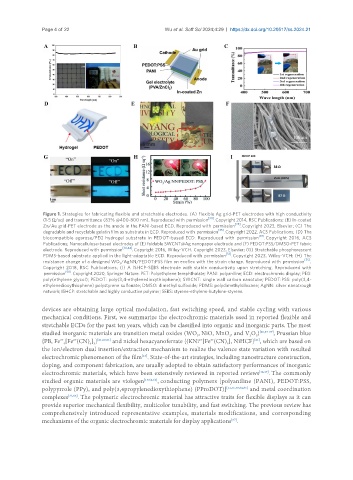
                Figure 1. Strategies for fabricating flexible and stretchable electrodes. (A) Flexible Ag grid-PET electrodes with high conductivity
                (1-5 Ω/sq) and transmittance (83% @400-800 nm). Reproduced with permission [30] . Copyright 2014, RSC Publications; (B) In-coated
                Zn/Au grid-PET electrode as the anode in the PANI-based ECD. Reproduced with  permission [28] . Copyright 2023, Elsevier; (C) The
                degradable and recyclable gelatin film as substrate in ECD. Reproduced with permission [35] . Copyright 2022, ACS Publications; (D) The
                biocompatible  agarose/PEG  hydrogel  substrate  in  PEDOT-based  ECD.  Reproduced  with  permission [37] . Copyright  2016,  ACS
                Publications; Nanocellulose-based electrodes of (E) foldable SWCNT@Ag nanopaper electrode and (F) PEDOT:PSS/DMSO-PET fabric
                electrode. Reproduced with  permission [38,44] . Copyright 2016, Wiley-VCH. Copyright 2023, Elsevier; (G) Stretchable phosphorescent
                PDMS-based substrate applied in the light-adaptable ECD. Reproduced with  permission [53] . Copyright 2023, Wiley-VCH; (H) The
                resistance change of a designed WO /AgNN/PEDOT:PSS film on ecoflex with the strain change. Reproduced with  permission [55] .
                                         3
                Copyright  2018,  RSC  Publications;  (I)  A  ISHCP-SEBS  electrode  with  stable  conductivity  upon  stretching.  Reproduced  with
                permission [50] . Copyright 2020, Springer Nature. PET: Polyethylene terephthalate; PANI: polyaniline; ECD: electrochromic display; PEG:
                poly(ethylene glycol); PEDOT: poly(3,4-ethylenedioxythiophene); SWCNT: single wall carbon nanotube; PEDOT:PSS: poly(3,4-
                ethylenedioxythiophene) polystyrene sulfonate; DMSO: dimethyl sulfoxide; PDMS: polydimethylsiloxane; AgNN: silver nanotrough
                network; ISHCP: stretchable and highly conductive polymer; SEBS: styrene-ethylene-butylene-styrene.

               devices are obtaining large optical modulation, fast switching speed, and stable cycling with various
               mechanical conditions. First, we summarize the electrochromic materials used in reported flexible and
               stretchable ECDs for the past ten years, which can be classified into organic and inorganic parts. The most
               studied inorganic materials are transition metal oxides (WO , NiO, MnO , and V O ) [20,57-59] , Prussian blue
                                                                                     2
                                                                                       5
                                                                              2
                                                                   3
                                                                                       [21]
                                                                    2+
                     3+
                          2+
               {PB, Fe [Fe (CN) ] } [21,60,61]  and nickel hexacyanoferrate {(KNi [Fe (CN) ], NiHCF} , which are based on
                                                                        3+
                               6 3
                      4
                                                                              6
               the ion/electron dual insertion/extraction mechanism to realize the valence state variation with resulted
                                                 [13]
               electrochromic phenomenon of the film . State-of-the-art strategies, including nanostructure construction,
               doping, and component fabrication, are usually adopted to obtain satisfactory performances of inorganic
               electrochromic materials, which have been extensively reviewed in reported reviews [12,17] . The commonly
               studied organic materials are viologen [19,62,63] , conducting polymers [polyaniline (PANI), PEDOT:PSS,
               polypyrrole (PPy), and poly(3,4propylenedioxythiophene) (PProDOT)] [31,35,38,64,65]  and metal coordination
               complexes [22,66] . The polymeric electrochromic material has attractive traits for flexible displays as it can
               provide superior mechanical flexibility, multicolor tunability, and fast switching. The previous review has
               comprehensively introduced representative examples, materials modifications, and corresponding
               mechanisms of the organic electrochromic materials for display applications .
                                                                               [67]

