


Page 68 - Read Online
P. 68
Page 14 of 22                             Wu et al. Soft Sci 2024;4:29  https://dx.doi.org/10.20517/ss.2024.21


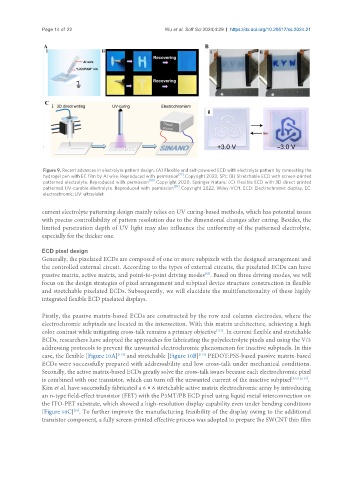
                Figure 9. Recent advances in electrolyte pattern design. (A) Flexible and self-powered ECD with electrolyte pattern by connecting the
                hydrogel pen with EC film by Al wire. Reproduced with  permission [21] . Copyright 2023, SPJ; (B) Stretchable ECD with screen-printed
                patterned electrolyte. Reproduced with  permission [50] . Copyright 2020, Springer Nature; (C) Flexible ECD with 3D direct printed
                patterned UV-curable electrolyte. Reproduced with  permission [20] . Copyright 2022, Wiley-VCH. ECD: Electrochromic display; EC:
                electrochromic; UV: ultraviolet.


               current electrolyte patterning design mainly relies on UV curing-based methods, which has potential issues
               with precise controllability of pattern resolution due to the dimensional changes after curing. Besides, the
               limited penetration depth of UV light may also influence the uniformity of the patterned electrolyte,
               especially for the thicker one.

               ECD pixel design
               Generally, the pixelated ECDs are composed of one or more subpixels with the designed arrangement and
               the controlled external circuit. According to the types of external circuits, the pixelated ECDs can have
               passive matrix, active matrix, and point-to-point driving modes . Based on three driving modes, we will
                                                                      [87]
               focus on the design strategies of pixel arrangement and subpixel device structure construction in flexible
               and stretchable pixelated ECDs. Subsequently, we will elucidate the multifunctionality of these highly
               integrated flexible ECD pixelated displays.


               Firstly, the passive matrix-based ECDs are constructed by the row and column electrodes, where the
               electrochromic subpixels are located in the intersection. With this matrix architecture, achieving a high
               color contrast while mitigating cross-talk remains a primary objective . In current flexible and stretchable
                                                                          [112]
               ECDs, researchers have adopted the approaches for fabricating the polyelectrolyte pixels and using the V/3
               addressing protocols to prevent the unwanted electrochromic phenomenon for inactive subpixels. In this
               case, the flexible [Figure 10A]  and stretchable [Figure 10B]  PEDOT:PSS-based passive matrix-based
                                         [113]
                                                                    [114]
               ECDs were successfully prepared with addressability and low cross-talk under mechanical conditions.
               Secondly, the active matrix-based ECDs greatly solve the cross-talk issues because each electrochromic pixel
               is combined with one transistor, which can turn off the unwanted current of the inactive subpixel [24,112,115] .
               Kim et al. have successfully fabricated a 6 × 6 stretchable active matrix electrochromic array by introducing
               an n-type field-effect transistor (FET) with the P3MT/PB ECD pixel using liquid metal interconnection on
               the ITO-PET substrate, which showed a high-resolution display capability even under bending conditions
               [Figure 10C] . To further improve the manufacturing feasibility of the display owing to the additional
                          [61]
               transistor component, a fully screen-printed effective process was adopted to prepare the SWCNT thin film

