


Page 67 - Read Online
P. 67
Wu et al. Soft Sci 2024;4:29  https://dx.doi.org/10.20517/ss.2024.21            Page 13 of 22


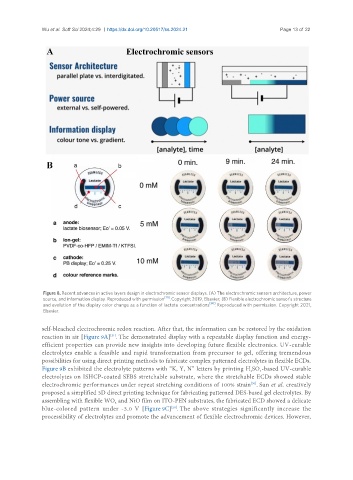
                Figure 8. Recent advances in active layers design in electrochromic sensor displays. (A) The electrochromic sensors architecture, power
                source, and information display. Reproduced with permission [111] . Copyright 2019, Elsevier; (B) Flexible electrochromic sensor’s structure
                and evolution of the display color change as a function of lactate  concentrations [60] . Reproduced with permission. Copyright 2021,
                Elsevier.

               self-bleached electrochromic redox reaction. After that, the information can be restored by the oxidation
               reaction in air [Figure 9A] . The demonstrated display with a repeatable display function and energy-
                                      [21]
               efficient properties can provide new insights into developing future flexible electronics. UV-curable
               electrolytes enable a feasible and rapid transformation from precursor to gel, offering tremendous
               possibilities for using direct printing methods to fabricate complex patterned electrolytes in flexible ECDs.
               Figure 9B exhibited the electrolyte patterns with “K, Y, N” letters by printing H SO -based UV-curable
                                                                                     2
                                                                                         4
               electrolytes on ISHCP-coated SEBS stretchable substrate, where the stretchable ECDs showed stable
               electrochromic performances under repeat stretching conditions of 100% strain . Sun et al. creatively
                                                                                      [50]
               proposed a simplified 3D direct printing technique for fabricating patterned DES-based gel electrolytes. By
               assembling with flexible WO  and NiO film on ITO-PEN substrates, the fabricated ECD showed a delicate
                                        3
               blue-colored  pattern  under  -3.0  V  [Figure 9C] . The  above  strategies  significantly  increase  the
                                                           [20]
               processibility of electrolytes and promote the advancement of flexible electrochromic devices. However,

