


Page 21 - Read Online
P. 21
Jo et al. Soft Sci 2024;4:27  https://dx.doi.org/10.20517/ss.2024.19             Page 9 of 14


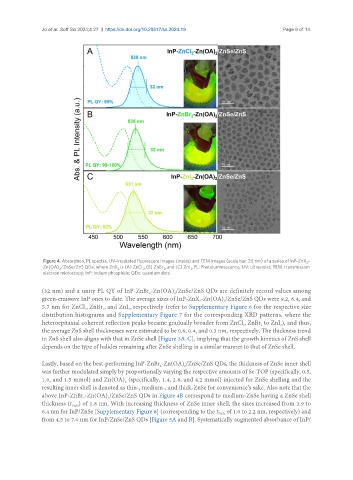
                Figure 4. Absorption, PL spectra, UV-irradiated fluorescent images (insets) and TEM images (scale bar: 20 nm) of a series of InP-ZnX -
                                                                                                        2
                Zn(OA) /ZnSe/ZnS QDs, where ZnX  is (A) ZnCl , (B) ZnBr , and (C) ZnI . PL: Photoluminescence; UV: ultraviolet; TEM: transmission
                     2
                                                        2
                                                                 2
                                                 2
                                         2
                electron microscopy; InP: indium phosphide; QDs: quantum dots.
               (32 nm) and a unity PL QY of InP-ZnBr -Zn(OA) /ZnSe/ZnS QDs are definitely record values among
                                                            2
                                                   2
               green-emissive InP ones to date. The average sizes of InP-ZnX -Zn(OA) /ZnSe/ZnS QDs were 9.2, 6.4, and
                                                                            2
                                                                    2
               5.7 nm for ZnCl , ZnBr , and ZnI , respectively (refer to Supplementary Figure 6 for the respective size
                              2
                                    2
                                            2
               distribution histograms and Supplementary Figure 7 for the corresponding XRD patterns, where the
               heteroepitaxial coherent reflection peaks became gradually broader from ZnCl , ZnBr  to ZnI ), and thus,
                                                                                                2
                                                                                   2
                                                                                         2
               the average ZnS shell thicknesses were estimated to be 0.6, 0.4, and 0.3 nm, respectively. The thickness trend
               in ZnS shell also aligns with that in ZnSe shell [Figure 3A-C], implying that the growth kinetics of ZnS shell
               depends on the type of halides remaining after ZnSe shelling in a similar manner to that of ZnSe shell.
               Lastly, based on the best-performing InP-ZnBr -Zn(OA) /ZnSe/ZnS QDs, the thickness of ZnSe inner shell
                                                       2
                                                               2
               was further modulated simply by proportionally varying the respective amounts of Se-TOP (specifically, 0.5,
               1.0, and 1.5 mmol) and Zn(OA)  (specifically, 1.4, 2.8, and 4.2 mmol) injected for ZnSe shelling and the
                                           2
               resulting inner shell is denoted as thin-, medium-, and thick-ZnSe for convenience’s sake. Also note that the
               above InP-ZnBr -Zn(OA) /ZnSe/ZnS QDs in Figure 4B correspond to medium-ZnSe having a ZnSe shell
                                     2
                             2
               thickness (t ) of 1.8 nm. With increasing thickness of ZnSe inner shell, the sizes increased from 3.9 to
                         ZnSe
               6.4 nm for InP/ZnSe [Supplementary Figure 8] (corresponding to the t  of 1.0 to 2.2 nm, respectively) and
                                                                           ZnSe
               from 4.5 to 7.0 nm for InP/ZnSe/ZnS QDs [Figure 5A and B]. Systematically augmented absorbance of InP/

