


Page 20 - Read Online
P. 20
Page 8 of 14                              Jo et al. Soft Sci 2024;4:27  https://dx.doi.org/10.20517/ss.2024.19


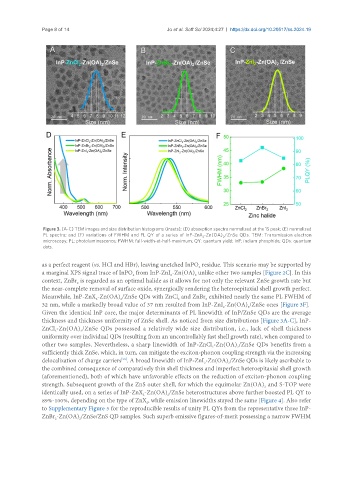
                Figure 3. (A-C) TEM images and size distribution histograms (insets); (D) absorption spectra normalized at the 1S peak; (E) normalized
                PL spectra; and (F) variations of FWHM and PL QY of a series of InP-ZnX -Zn(OA) /ZnSe QDs. TEM: Transmission electron
                                                                     2
                                                                            2
                microscopy; PL: photoluminescence; FWHM: full-width-at-half-maximum; QY: quantum yield; InP: indium phosphide; QDs: quantum
                dots.
               as a perfect reagent (vs. HCl and HBr), leaving unetched InPO  residue. This scenario may be supported by
                                                                    x
               a marginal XPS signal trace of InPO  from InP-ZnI -Zn(OA)  unlike other two samples [Figure 2C]. In this
                                                          2
                                              x
                                                                   2
               context, ZnBr  is regarded as an optimal halide as it allows for not only the relevant ZnSe growth rate but
                           2
               the near-complete removal of surface oxide, synergically rendering the heteroepitaxial shell growth perfect.
               Meanwhile, InP-ZnX -Zn(OA) /ZnSe QDs with ZnCl  and ZnBr  exhibited nearly the same PL FWHM of
                                          2
                                 2
                                                                      2
                                                             2
               32 nm, while a markedly broad value of 37 nm resulted from InP-ZnI -Zn(OA) /ZnSe ones [Figure 3F].
                                                                                     2
                                                                            2
               Given the identical InP core, the major determinants of PL linewidth of InP/ZnSe QDs are the average
               thickness and thickness uniformity of ZnSe shell. As noticed from size distributions [Figure 3A-C], InP-
               ZnCl -Zn(OA) /ZnSe QDs possessed a relatively wide size distribution, i.e., lack of shell thickness
                            2
                   2
               uniformity over individual QDs (resulting from an uncontrollably fast shell growth rate), when compared to
               other two samples. Nevertheless, a sharp linewidth of InP-ZnCl -Zn(OA) /ZnSe QDs benefits from a
                                                                                 2
                                                                        2
               sufficiently thick ZnSe, which, in turn, can mitigate the exciton-phonon coupling strength via the increasing
               delocalization of charge carriers . A broad linewidth of InP-ZnI -Zn(OA) /ZnSe QDs is likely ascribable to
                                          [55]
                                                                      2
                                                                              2
               the combined consequence of comparatively thin shell thickness and imperfect heteroepitaxial shell growth
               (aforementioned), both of which have unfavorable effects on the reduction of exciton-phonon coupling
               strength. Subsequent growth of the ZnS outer shell, for which the equimolar Zn(OA)  and S-TOP were
                                                                                          2
               identically used, on a series of InP-ZnX -Zn(OA) /ZnSe heterostructures above further boosted PL QY to
                                                 2
                                                         2
               89%-100%, depending on the type of ZnX , while emission linewidths stayed the same [Figure 4]. Also refer
                                                  2
               to Supplementary Figure 5 for the reproducible results of unity PL QYs from the representative three InP-
               ZnBr -Zn(OA) /ZnSe/ZnS QD samples. Such superb emissive figures-of-merit possessing a narrow FWHM
                            2
                    2

