


Page 18 - Read Online
P. 18
Page 6 of 14                              Jo et al. Soft Sci 2024;4:27  https://dx.doi.org/10.20517/ss.2024.19


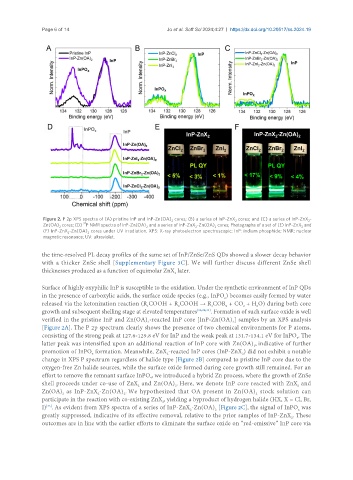
                Figure 2. P 2p XPS spectra of (A) pristine InP and InP-Zn(OA)  cores; (B) a series of InP-ZnX  cores; and (C) a series of InP-ZnX -
                                                           2                    2                        2
                             31
                Zn(OA)  cores; (D)  P NMR spectra of InP-Zn(OA)  and a series of InP-ZnX -Zn(OA)  cores; Photographs of a set of (E) InP-ZnX  and
                     2                            2                2     2                             2
                (F) InP-ZnX -Zn(OA)  cores under UV irradiation. XPS: X-ray photoelectron spectroscopic; InP: indium phosphide; NMR: nuclear
                        2      2
                magnetic resonance; UV: ultraviolet.
               the time-resolved PL decay profiles of the same set of InP/ZnSe/ZnS QDs showed a slower decay behavior
               with a thicker ZnSe shell [Supplementary Figure 3C]. We will further discuss different ZnSe shell
               thicknesses produced as a function of equimolar ZnX  later.
                                                            2

               Surface of highly oxyphilic InP is susceptible to the oxidation. Under the synthetic environment of InP QDs
               in the presence of carboxylic acids, the surface oxide species (e.g., InPO ) becomes easily formed by water
                                                                             x
               released via the ketonization reaction (R COOH + R COOH → R COR  + CO  + H O) during both core
                                                                                        2
                                                   1
                                                                                   2
                                                             2
                                                                        1
                                                                             2
               growth and subsequent shelling stage at elevated temperatures [32,36,44] . Formation of such surface oxide is well
               verified in the pristine InP and Zn(OA) -reacted InP core [InP-Zn(OA) ] samples by an XPS analysis
                                                                               2
                                                   2
               [Figure 2A]. The P 2p spectrum clearly shows the presence of two chemical environments for P atoms,
               consisting of the strong peak at 127.6-129.8 eV for InP and the weak peak at 131.7-134.1 eV for InPO . The
                                                                                                     x
               latter peak was intensified upon an additional reaction of InP core with Zn(OA) , indicative of further
                                                                                       2
               promotion of InPO  formation. Meanwhile, ZnX -reacted InP cores (InP-ZnX ) did not exhibit a notable
                                                         2
                                                                                   2
                                x
               change in XPS P spectrum regardless of halide type [Figure 2B] compared to pristine InP core due to the
               oxygen-free Zn halide sources, while the surface oxide formed during core growth still remained. For an
               effort to remove the remnant surface InPO , we introduced a hybrid Zn process, where the growth of ZnSe
                                                    4
               shell proceeds under co-use of ZnX  and Zn(OA) . Here, we denote InP core reacted with ZnX  and
                                               2
                                                            2
                                                                                                     2
               Zn(OA)  as InP-ZnX -Zn(OA) . We hypothesized that OA present in Zn(OA)  stock solution can
                                                                                       2
                                  2
                                           2
                      2
               participate in the reaction with co-existing ZnX , yielding a byproduct of hydrogen halide (HX, X = Cl, Br,
                                                        2
               I) . As evident from XPS spectra of a series of InP-ZnX -Zn(OA)  [Figure 2C], the signal of InPO  was
                 [45]
                                                                         2
                                                                 2
                                                                                                     x
               greatly suppressed, indicative of its effective removal, relative to the prior samples of InP-ZnX . These
                                                                                                   2
               outcomes are in line with the earlier efforts to eliminate the surface oxide on “red-emissive” InP core via

