


Page 56 - Read Online
P. 56
Zhu et al. Soft Sci 2024;4:21  https://dx.doi.org/10.20517/ss.2024.01            Page 5 of 10

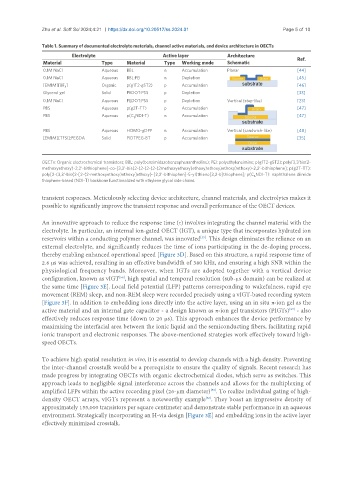
               Table 1. Summary of documented electrolyte materials, channel active materials, and device architecture in OECTs
                         Electrolyte                    Active layer          Architecture
                Material           Type     Material    Type  Working mode    Schematic              Ref.
                0.1M NaCl          Aqueous  BBL         n     Accumulation    Planar                 [44]
                0.1M NaCl          Aqueous  BBL:PEI     n     Depletion                              [45]
                [EMIM][BF ]        Organic  p(g1T2-g5T2)  p   Accumulation                           [46]
                       4
                Glycerol gel       Solid    PEDOT:PSS   p     Depletion                              [33]
                0.1M NaCl          Aqueous  PEDOT:PSS   p     Depletion       Vertical (step-like)   [23]
                PBS                Aqueous  p(g2T-TT)   p     Accumulation                           [47]
                PBS                Aqueous  p(C NDI-T)  n     Accumulation                           [47]
                                              6
                PBS                Aqueous  HOMO-gDPP   n     Accumulation    Vertical (sandwich-like)   [48]
                [EMIM][TFSI]:PEGDA  Solid   PIDTPEG-BT  p     Accumulation                           [35]


               OECTs: Organic electrochemical transistors; BBL: poly(benzimidazobenzophenanthroline); PEI: polyethyleneimine; p(g1T2-g5T2): poly[3,3’bis(2-
               methoxyethoxy)-2,2’-bithiophene]-co-[3,3’-bis(2-(2-(2-(2-(2methoxyethoxy)ethoxy)ethoxy)ethoxy)ethoxy)-2,2’-bithiophene]; p(g2T-TT):
               poly[2-(3,3’-bis{2-[2-(2-methoxyethoxy)ethoxy]ethoxy}-[2,2’-bithiophen]-5-yl)thieno[3,2-b]thiophene]; p(C NDI-T): naphthalene diimide
                                                                                       6
               thiophene-based (NDI-T) backbone functionalized with ethylene glycol side chains.

               transient responses. Meticulously selecting device architecture, channel materials, and electrolytes makes it
               possible to significantly improve the transient response and overall performance of the OECT devices.


               An innovative approach to reduce the response time (τ) involves integrating the channel material with the
               electrolyte. In particular, an internal ion-gated OECT (IGT), a unique type that incorporates hydrated ion
               reservoirs within a conducting polymer channel, was innovated . This design eliminates the reliance on an
                                                                     [55]
               external electrolyte, and significantly reduces the time of ions participating in the de-doping process,
               thereby enabling enhanced operational speed [Figure 3D]. Based on this structure, a rapid response time of
               2.6 μs was achieved, resulting in an effective bandwidth of 380 kHz, and ensuring a high SNR within the
               physiological frequency bands. Moreover, when IGTs are adopted together with a vertical device
               configuration, known as vIGT , high spatial and temporal resolution (sub-µs domain) can be realized at
                                         [56]
               the same time [Figure 3E]. Local field potential (LFP) patterns corresponding to wakefulness, rapid eye
               movement (REM) sleep, and non-REM sleep were recorded precisely using a vIGT-based recording system
               [Figure 3F]. In addition to embedding ions directly into the active layer, using an in situ π-ion gel as the
               active material and an internal gate capacitor - a design known as π-ion gel transistors (PIGTs)  - also
                                                                                                   [57]
               effectively reduces response time (down to 20 µs). This approach enhances the device performance by
               maximizing the interfacial area between the ionic liquid and the semiconducting fibers, facilitating rapid
               ionic transport and electronic responses. The above-mentioned strategies work effectively toward high-
               speed OECTs.


               To achieve high spatial resolution in vivo, it is essential to develop channels with a high density. Preventing
               the inter-channel crosstalk would be a prerequisite to ensure the quality of signals. Recent research has
               made progress by integrating OECTs with organic electrochemical diodes, which serve as switches. This
               approach leads to negligible signal interference across the channels and allows for the multiplexing of
                                                                        [58]
               amplified LFPs within the active recording pixel (26-μm diameter) . To realize individual gating of high-
               density OECT arrays, vIGTs represent a noteworthy example . They boast an impressive density of
                                                                      [56]
               approximately 155,000 transistors per square centimeter and demonstrate stable performance in an aqueous
               environment. Strategically incorporating an H-via design [Figure 3E] and embedding ions in the active layer
               effectively minimized crosstalk.

