


Page 55 - Read Online
P. 55
Page 4 of 10                             Zhu et al. Soft Sci 2024;4:21  https://dx.doi.org/10.20517/ss.2024.01

                                                                [36]
               Using ion gels, formulated with gelatin, PBS, and glycerin , in conjunction with the well-established active
               material poly(3,4-ethylenedioxythiophene):poly(styrene sulfonate) (PEDOT:PSS), successful and stable
               mapping of ECG signals was accomplished via an OECT array [Figure 3A]. The devices retained high
               performance after medium-intensity exercise, demonstrating their potential for sports-related applications.
               Moreover, using a gelatin-glycerol electrolyte as the substrate facilitated the construction of a highly
                                                                                                      [40]
               stretchable OECT, designed to adapt to skin deformation, ensuring stable recording and conformability .
               For the long-term application of wearable OECTs on the skin, it is crucial to ensure both the operational
               stability of the devices and the comfort of the users. The integration of nonvolatile solid electrolytes could
               significantly enhance the operational stability. For instance, glycerol gel has been used as a solid electrolyte
               to realize continuous electrophysiological monitoring for several hours and demonstrates stability in the air
                                     [33]
               for more than seven days . In addition, gas-permeable materials and devices have been developed [41,42] ,
               effectively mitigating potential skin irritation or device degradation. For example, a gas-permeable solid-
               state polymer electrolyte (SPE) [Figure 3B] was applied in fibrous nano-mesh OECT, realizing “breathable”
               OECTs that exhibit high-quality electrophysiological recordings . Ultrathin hydrogel films with a
                                                                          [41]
               thickness down to 10 µm have been developed recently and applied as universal biocompatible interfaces
               towards breathable, skin-integrated electronics [Figure 3C] .
                                                                 [42]

               For in vivo recordings, high spatial and temporal resolution are crucial for capturing the intricate dynamics
               of intercellular and intracellular communication and accurately recording high-frequency signals. Although
               the in vivo environment is naturally aqueous, and the tissue fluid can function as an electrolyte, electrolyte
               engineering can still solve persisting challenges.

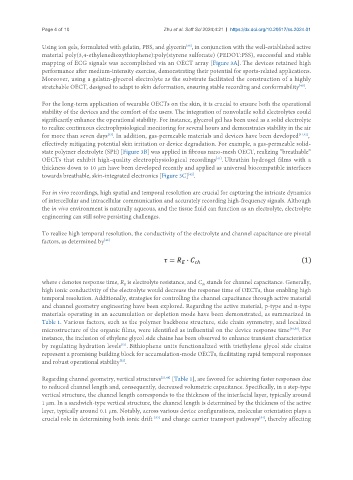
               To realize high temporal resolution, the conductivity of the electrolyte and channel capacitance are pivotal
               factors, as determined by [43]


               where τ denotes response time, R  is electrolyte resistance, and C  stands for channel capacitance. Generally,
                                           E
                                                                     ch
               high ionic conductivity of the electrolyte would decrease the response time of OECTs, thus enabling high
               temporal resolution. Additionally, strategies for controlling the channel capacitance through active material
               and channel geometry engineering have been explored. Regarding the active material, p-type and n-type
               materials operating in an accumulation or depletion mode have been demonstrated, as summarized in
               Table 1. Various factors, such as the polymer backbone structure, side chain symmetry, and localized
               microstructure of the organic films, were identified as influential on the device response time [49,50] . For
               instance, the inclusion of ethylene glycol side chains has been observed to enhance transient characteristics
               by regulating hydration levels . Bithiophene units functionalized with triethylene glycol side chains
                                          [51]
               represent a promising building block for accumulation-mode OECTs, facilitating rapid temporal responses
                                         [52]
               and robust operational stability .

               Regarding channel geometry, vertical structures [23,48]  [Table 1], are favored for achieving faster responses due
               to reduced channel length and, consequently, decreased volumetric capacitance. Specifically, in a step-type
               vertical structure, the channel length corresponds to the thickness of the interfacial layer, typically around
               1 μm. In a sandwich-type vertical structure, the channel length is determined by the thickness of the active
               layer, typically around 0.1 μm. Notably, across various device configurations, molecular orientation plays a
               crucial role in determining both ionic drift   and charge carrier transport pathways , thereby affecting
                                                                                        [54]
                                                     [53]

