


Page 87 - Read Online
P. 87
Page 8 of 35                         Kulkarni et al. Soft Sci. 2025, 5, 12  https://dx.doi.org/10.20517/ss.2023.51


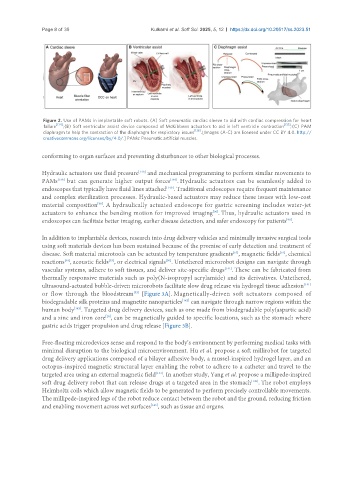
                Figure 2. Use of PAMs in implantable soft robots. (A) Soft pneumatic cardiac sleeve to aid with cardiac compression for heart
                    [134]                                                                        [135]
                failure  ; (B) Soft ventricular assist device composed of McKibbens actuators to aid in left ventricle  contraction  ; (C) PAM
                                                                  [136]
                diaphragm to help the contraction of the diaphragm for respiratory  issues  . [Images (A-C) are licensed under CC BY 4.0. http://
                creativecommons.org/licenses/by/4.0/.] PAMs: Pneumatic artificial muscles.
               conforming to organ surfaces and preventing disturbances to other biological processes.


               Hydraulic actuators use fluid pressure  and mechanical programming to perform similar movements to
                                                [138]
               PAMs  but can generate higher output forces . Hydraulic actuators can be seamlessly added to
                                                          [139]
                    [138]
               endoscopes that typically have fluid lines attached . Traditional endoscopes require frequent maintenance
                                                         [140]
               and complex sterilization processes. Hydraulic-based actuators may reduce these issues with low-cost
               material composition . A hydraulically actuated endoscope for gastric screening includes water-jet
                                  [90]
                                                                         [90]
               actuators to enhance the bending motion for improved imaging . Thus, hydraulic actuators used in
               endoscopes can facilitate better imaging, earlier disease detection, and safer endoscopy for patients .
                                                                                                  [90]
               In addition to implantable devices, research into drug delivery vehicles and minimally invasive surgical tools
               using soft materials devices has been sustained because of the promise of early detection and treatment of
               disease. Soft material microtools can be actuated by temperature gradients , magnetic fields , chemical
                                                                                               [51]
                                                                                [52]
               reactions , acoustic fields , or electrical signals . Untethered microrobot designs can navigate through
                                                         [50]
                                      [53]
                       [49]
               vascular systems, adhere to soft tissues, and deliver site-specific drugs . These can be fabricated from
                                                                             [141]
               thermally responsive materials such as poly(N-isopropyl acrylamide) and its derivatives. Untethered,
               ultrasound-actuated bubble-driven microrobots facilitate slow drug release via hydrogel tissue adhesion
                                                                                                       [141]
                                              [53]
               or  flow  through  the  bloodstream   [Figure 3A]. Magnetically-driven  soft  actuators  composed  of
               biodegradable silk proteins and magnetite nanoparticles  can navigate through narrow regions within the
                                                              [142]
               human body . Targeted drug delivery devices, such as one made from biodegradable poly(aspartic acid)
                          [143]
               and a zinc and iron core , can be magnetically guided to specific locations, such as the stomach where
                                     [20]
               gastric acids trigger propulsion and drug release [Figure 3B].
               Free-floating microdevices sense and respond to the body’s environment by performing medical tasks with
               minimal disruption to the biological microenvironment. Hu et al. propose a soft millirobot for targeted
               drug delivery applications composed of a bilayer adhesive body, a mussel-inspired hydrogel layer, and an
               octopus-inspired magnetic structural layer enabling the robot to adhere to a catheter and travel to the
               targeted area using an external magnetic field . In another study, Yang et al. propose a millipede-inspired
                                                      [144]
               soft drug delivery robot that can release drugs at a targeted area in the stomach . The robot employs
                                                                                      [145]
               Helmholtz coils which allow magnetic fields to be generated to perform precisely controllable movements.
               The millipede-inspired legs of the robot reduce contact between the robot and the ground, reducing friction
               and enabling movement across wet surfaces , such as tissue and organs.
                                                    [145]

