


Page 90 - Read Online
P. 90
Kulkarni et al. Soft Sci. 2025, 5, 12  https://dx.doi.org/10.20517/ss.2023.51   Page 11 of 35


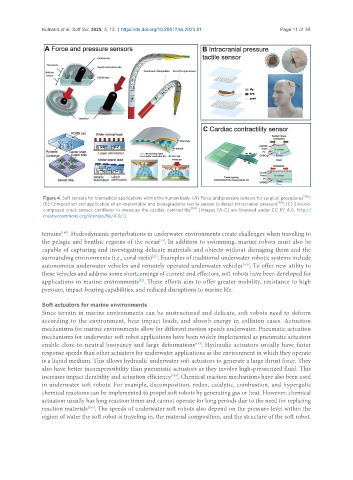
                Figure 4. Soft sensors for biomedical applications within the human body. (A) Force and pressure sensors for surgical  procedures [156] ;
                (B) Composition and application of an implantable and biodegradable tactile sensor to detect intracranial  pressure [158] ; (C) Silicone-
                composed crack sensor cantilever to measure the cardiac  contractility [161] . [Images (A-C) are licensed under CC BY 4.0. http://
                creativecommons.org/licenses/by/4.0/.]

               terrains . Hydrodynamic perturbations in underwater environments create challenges when traveling to
                      [165]
               the pelagic and benthic regions of the ocean . In addition to swimming, marine robots must also be
                                                       [21]
               capable of capturing and investigating delicate materials and objects without damaging them and the
               surrounding environments (i.e., coral reefs) . Examples of traditional underwater robotic systems include
                                                    [21]
                                                                                   [166]
               autonomous underwater vehicles and remotely operated underwater vehicles . To offer new utility to
               these vehicles and address some shortcomings of current end effectors, soft robots have been developed for
                                                [21]
               applications in marine environments . These efforts aim to offer greater mobility, resistance to high
               pressure, impact-bearing capabilities, and reduced disruptions to marine life.


               Soft actuators for marine environments
               Since terrain in marine environments can be unstructured and delicate, soft robots need to deform
               according to the environment, bear impact loads, and absorb energy in collision cases. Actuation
               mechanisms for marine environments allow for different motion speeds underwater. Pneumatic actuation
               mechanisms for underwater soft robot applications have been widely implemented as pneumatic actuators
               enable close-to-neutral buoyancy and large deformations . Hydraulic actuators usually have faster
                                                                   [167]
               response speeds than other actuators for underwater applications as the environment in which they operate
               is a liquid medium. This allows hydraulic underwater soft actuators to generate a large thrust force. They
               also have better incompressibility than pneumatic actuators as they involve high-pressurized fluid. This
                                                           [168]
               increases impact durability and actuation efficiency . Chemical reaction mechanisms have also been used
               in underwater soft robots. For example, decomposition, redox, catalytic, combustion, and hypergolic
               chemical reactions can be implemented to propel soft robots by generating gas or heat. However, chemical
               actuation usually has long reaction times and cannot operate for long periods due to the need for replacing
               reaction materials . The speeds of underwater soft robots also depend on the pressure level within the
                               [167]
               region of water the soft robot is traveling in, the material composition, and the structure of the soft robot.

