


Page 94 - Read Online
P. 94
Kulkarni et al. Soft Sci. 2025, 5, 12  https://dx.doi.org/10.20517/ss.2023.51   Page 15 of 35


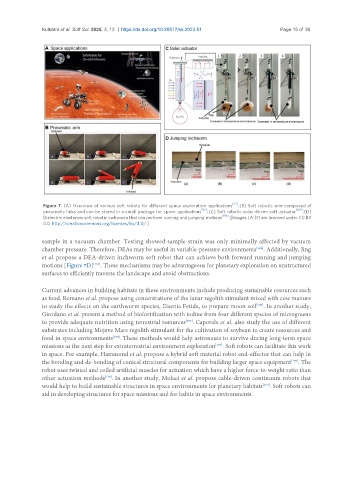
                Figure 7. (A) Overview of various soft robots for different space exploration  applications [22] ; (B) Soft robotic arm composed of
                pneumatic links and can be stored in a small package for space  applications [92] ; (C) Soft robotic solar-driven soft  actuator [193] ; (D)
                Dielectric elastomer soft robotic inchworm that can perform running and jumping motions [195] . [Images (A-D) are licensed under CC BY
                4.0. http://creativecommons.org/licenses/by/4.0/.]

               sample in a vacuum chamber. Testing showed sample strain was only minimally affected by vacuum
               chamber pressure. Therefore, DEAs may be useful in variable-pressure environments . Additionally, Jing
                                                                                       [194]
               et al. propose a DEA-driven inchworm soft robot that can achieve both forward running and jumping
                                [195]
               motions [Figure 7D] . These mechanisms may be advantageous for planetary exploration on unstructured
               surfaces to efficiently traverse the landscape and avoid obstructions.

               Current advances in building habitats in these environments include producing sustainable resources such
               as food. Romano et al. propose using concentrations of the lunar regolith stimulant mixed with cow manure
                                                                                       [196]
               to study the effects on the earthworm species, Eisenia Fetida, to prepare moon soil . In another study,
               Giordano et al. present a method of biofortification with iodine from four different species of microgreens
               to provide adequate nutrition using terrestrial resources . Caporale et al. also study the use of different
                                                                [197]
               substrates including Mojave Mars regolith stimulant for the cultivation of soybean to create resources and
                                       [198]
               food in space environments . These methods would help astronauts to survive during long-term space
               missions as the next step for extraterrestrial environment exploration . Soft robots can facilitate this work
                                                                          [197]
               in space. For example, Hammond et al. propose a hybrid soft material robot end-effector that can help in
                                                                                                   [199]
               the bonding and de-bonding of conical structural components for building larger space equipment . The
               robot uses twisted and coiled artificial muscles for actuation which have a higher force-to-weight ratio than
               other actuation methods . In another study, Molaei et al. propose cable-driven continuum robots that
                                    [199]
               would help to build sustainable structures in space environments for planetary habitats . Soft robots can
                                                                                          [200]
               aid in developing structures for space missions and for habits in space environments.

