


Page 92 - Read Online
P. 92
Kulkarni et al. Soft Sci. 2025, 5, 12  https://dx.doi.org/10.20517/ss.2023.51   Page 13 of 35


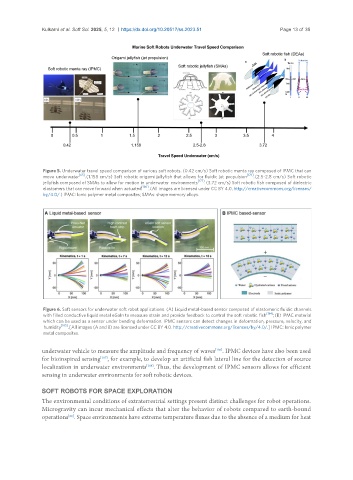
                Figure 5. Underwater travel speed comparison of various soft robots. (0.42 cm/s) Soft robotic manta ray composed of IPMC that can
                move  underwater [65] . (1.158 cm/s) Soft robotic origami jellyfish that allows for fluidic jet  propulsion [173] . (2.5-2.8 cm/s) Soft robotic
                jellyfish composed of SMAs to allow for motion in underwater  environments [177] . (3.72 cm/s) Soft robotic fish composed of dielectric
                elastomers that can move forward when actuated [180] . (All images are licensed under CC BY 4.0. http://creativecommons.org/licenses/
                by/4.0/.) IPMC: Ionic polymer metal composites; SMAs: shape memory alloys.


                Figure 6. Soft sensors for underwater soft robot applications. (A) Liquid metal-based sensor composed of elastomeric fluidic channels
                with filled conductive liquid metal eGaIn to measure strain and provide feedback to control the soft robotic  fish [184] ; (B) IPMC material
                which can be used as a sensor under bending deformation. IPMC sensors can detect changes in deformation, pressure, velocity, and
                      [185]
                humidity  . [All images (A and B) are licensed under CC BY 4.0. http://creativecommons.org/licenses/by/4.0/.] IPMC: Ionic polymer
                metal composites.

               underwater vehicle to measure the amplitude and frequency of waves . IPMC devices have also been used
                                                                          [186]
                                   [187]
               for bioinspired sensing , for example, to develop an artificial fish lateral line for the detection of source
               localization in underwater environments . Thus, the development of IPMC sensors allows for efficient
                                                  [188]
               sensing in underwater environments for soft robotic devices.

               SOFT ROBOTS FOR SPACE EXPLORATION
               The environmental conditions of extraterrestrial settings present distinct challenges for robot operations.
               Microgravity can incur mechanical effects that alter the behavior of robots compared to earth-bound
               operations . Space environments have extreme temperature fluxes due to the absence of a medium for heat
                        [22]

