


Page 88 - Read Online
P. 88
Kulkarni et al. Soft Sci. 2025, 5, 12  https://dx.doi.org/10.20517/ss.2023.51    Page 9 of 35


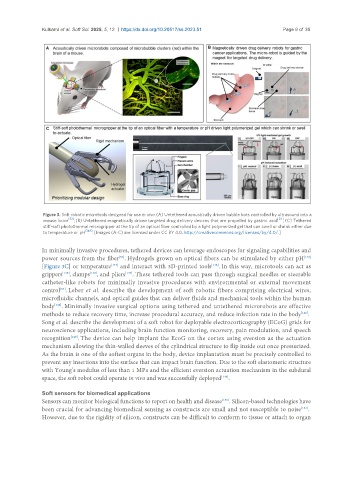
                Figure 3. Soft robotic microtools designed for use in vivo. (A) Untethered acoustically driven bubble bots controlled by ultrasound into a
                mouse  brain [53] ; (B) Untethered magnetically driven targeted drug delivery devices that are propelled by gastric  acid [20] ; (C) Tethered
                stiff-soft photothermal microgripper at the tip of an optical fiber controlled by a light polymerized gel that can swell or shrink either due
                to temperature or pH [146] . [Images (A-C) are licensed under CC BY 4.0. http://creativecommons.org/licenses/by/4.0/.]


               In minimally invasive procedures, tethered devices can leverage endoscopes for signaling capabilities and
               power sources from the fiber . Hydrogels grown on optical fibers can be stimulated by either pH
                                                                                                       [146]
                                         [54]
                                                                        [146]
                                      [147]
               [Figure 3C] or temperature  and interact with 3D-printed tools . In this way, microtools can act as
               grippers , clamps , and pliers . These tethered tools can pass through surgical needles or steerable
                               [146]
                                           [147]
                      [146]
               catheter-like robots for minimally invasive procedures with environmental or external movement
               control . Leber et al. describe the development of soft robotic fibers comprising electrical wires,
                     [54]
               microfluidic channels, and optical guides that can deliver fluids and mechanical tools within the human
               body . Minimally invasive surgical options using tethered and untethered microrobots are effective
                   [148]
               methods to reduce recovery time, increase procedural accuracy, and reduce infection rate in the body .
                                                                                                      [146]
               Song et al. describe the development of a soft robot for deployable electrocorticography (ECoG) grids for
               neuroscience applications, including brain function monitoring, recovery, pain modulation, and speech
               recognition . The device can help implant the EcoG on the cortex using eversion as the actuation
                         [149]
               mechanism allowing the thin-walled sleeves of the cylindrical structure to flip inside out once pressurized.
               As the brain is one of the softest organs in the body, device implantation must be precisely controlled to
               prevent any insertions into the surface that can impact brain function. Due to the soft elastomeric structure
               with Young’s modulus of less than 1 MPa and the efficient eversion actuation mechanism in the subdural
                                                                            [149]
               space, the soft robot could operate in vivo and was successfully deployed .
               Soft sensors for biomedical applications
                                                                            [150]
               Sensors can monitor biological functions to report on health and disease . Silicon-based technologies have
               been crucial for advancing biomedical sensing as constructs are small and not susceptible to noise .
                                                                                                      [151]
               However, due to the rigidity of silicon, constructs can be difficult to conform to tissue or attach to organ

