


Page 84 - Read Online
P. 84
Kulkarni et al. Soft Sci. 2025, 5, 12 https://dx.doi.org/10.20517/ss.2023.51 Page 5 of 35
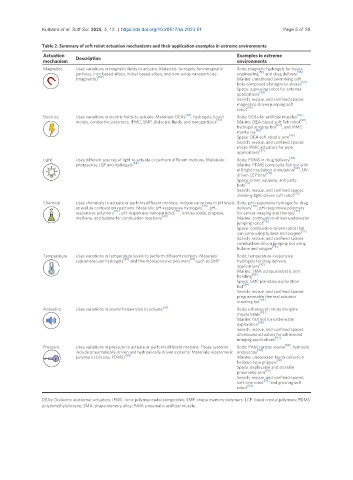
Table 2. Summary of soft robot actuation mechanisms and their application examples in extreme environments
Actuation Description Examples in extreme
mechanism environments
Magnetics Uses variations in magnetic fields to actuate. Materials: ferrogels, ferromagnetic Body: magnetic hydrogels for tissue
particles, iron-based alloys, nickel-based alloys, and iron-oxide nanoparticles engineering [56] and drug delivery [56]
[55]
(magnetite) Marine: untethered swimming soft
bots composed of magnetic sheets [57]
Space: a growing robot for antenna
[58]
applications
Search, rescue, and confined spaces:
magnetics-driven jumping soft
robot [59]
[60] [62]
Electrics Uses variations in electric fields to actuate. Materials: DEAs , hydrogels, liquid Body: DEAs for artificial muscles
metals, conductive polymers, IPMC, SMP, dielectric fluids, and nanoparticles [61] Marine: DEA-based soft fish robot [63] ,
[64]
hydrogel stingray bot , and IPMC
manta ray [65]
[66]
Space: DEA soft robotic arm
Search, rescue, and confined spaces:
micro IPMC actuators for pipe
[67]
applications
[69]
Light Uses different sources of light to actuate or perform different motions. Materials: Body: PDMS in drug delivery
[68]
photoactive LCP and hydrogels Marine: PDMS composite fish bot with
nIR light irradiation stimulation [69] , UV-
[70]
driven LCP bots
Space: crawl, squeeze, and jump
[71]
bots
Search, rescue, and confined spaces:
[72]
climbing light-driven soft robot
Chemical Uses chemicals to actuate or perform different motions. Include variations in pH levels Body: pH-responsive hydrogel for drug
[73] [75]
as well as combustion reactions. Materials: pH-responsive hydrogels , pH- delivery , pH-responsive polymers
[74] [75] [77]
responsive polymers , pH-responsive nanoparticles , nitrous oxide, propane, for cancer imaging and therapy
[76]
methane, and butane for combustion reactions Marine: combustion-driven underwater
[78]
jumping robot
Space: combustion-driven robot that
can jump using butane and oxygen [22]
Search, rescue, and confined spaces:
combustion-driven jumping bot using
butane and oxygen [79]
Temperature Uses variations in temperature levels to perform different motions. Materials: Body: temperature-responsive
supramolecular hydrogels [80] and thermoresponsive polymers [81] such as SMP hydrogels for drug delivery
[82]
applications
Marine: SMA octopus robotic arm
[83]
bending
Space: SMP planetary exploration
[84]
bot
Search, rescue, and confined spaces:
programmable thermal actuator
[85]
crawling bot
Acoustics Uses variations in sound frequencies to actuate [53] Body: ultrasound robots navigate
[53]
mouse brain
Marine: fish bot for underwater
[86]
exploration
Search, rescue, and confined spaces:
ultrasound actuators for ultrasound
[87]
imaging applications
[89]
Pressure Uses variations in pressure to actuate or perform different motions. These systems Body: PAM cardiac sleeve , hydraulic
[90]
include pneumatically driven and hydraulically driven systems. Materials: elastomeric endoscope
polymers (silicone, PDMS) [88] Marine: underwater fauna collection
bellows-type grippers [91]
Space: deployable and storable
[92]
pneumatic arm
Search, rescue, and confined spaces:
[93]
soft vine robot and growing soft
robot [94]
DEAs: Dielectric elastomer actuators; IPMC: ionic polymer metal composites; SMP: shape memory polymers; LCP: liquid crystal polymers; PDMS:
polydimethylsiloxane; SMA: shape memory alloy; PAM: pneumatic artificial muscle.

