


Page 82 - Read Online
P. 82
Kulkarni et al. Soft Sci. 2025, 5, 12  https://dx.doi.org/10.20517/ss.2023.51    Page 3 of 35


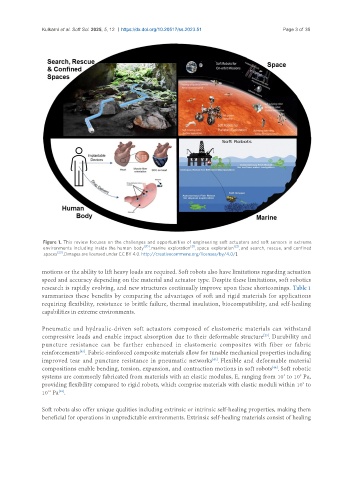
                Figure 1. This review focuses on the challenges and opportunities of engineering soft actuators and soft sensors in extreme
                environments including inside the human  body [20] , marine  exploration [21] , space  exploration [22] , and search, rescue, and confined
                spaces [23] . [Images are licensed under CC BY 4.0. http://creativecommons.org/licenses/by/4.0/].

               motions or the ability to lift heavy loads are required. Soft robots also have limitations regarding actuation
               speed and accuracy depending on the material and actuator type. Despite these limitations, soft robotics
               research is rapidly evolving, and new structures continually improve upon these shortcomings. Table 1
               summarizes these benefits by comparing the advantages of soft and rigid materials for applications
               requiring flexibility, resistance to brittle failure, thermal insulation, biocompatibility, and self-healing
               capabilities in extreme environments.

               Pneumatic and hydraulic-driven soft actuators composed of elastomeric materials can withstand
               compressive loads and enable impact absorption due to their deformable structure . Durability and
                                                                                          [25]
               puncture  resistance  can  be  further  enhanced  in  elastomeric  composites  with  fiber  or  fabric
               reinforcements . Fabric-reinforced composite materials allow for tunable mechanical properties including
                            [43]
               improved tear and puncture resistance in pneumatic networks . Flexible and deformable material
                                                                         [43]
               compositions enable bending, torsion, expansion, and contraction motions in soft robots . Soft robotic
                                                                                             [44]
               systems are commonly fabricated from materials with an elastic modulus, E, ranging from 10  to 10  Pa,
                                                                                                      9
                                                                                                 4
                                                                                                       9
               providing flexibility compared to rigid robots, which comprise materials with elastic moduli within 10  to
               10  Pa .
                     [28]
                 12
               Soft robots also offer unique qualities including extrinsic or intrinsic self-healing properties, making them
               beneficial for operations in unpredictable environments. Extrinsic self-healing materials consist of healing

