


Page 83 - Read Online
P. 83
Page 4 of 35                         Kulkarni et al. Soft Sci. 2025, 5, 12  https://dx.doi.org/10.20517/ss.2023.51

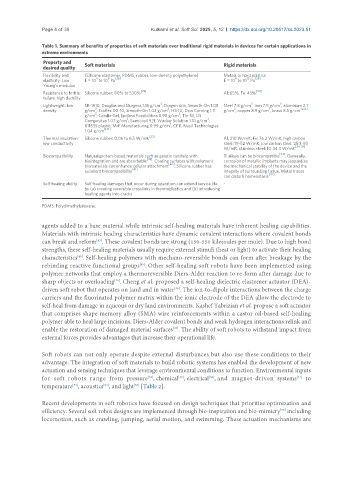
               Table 1. Summary of benefits of properties of soft materials over traditional rigid materials in devices for certain applications in
               extreme environments
                Property and   Soft materials                               Rigid materials
                desired quality
                Flexibility and   (Silicone elastomer, PDMS, rubber, low-density polyethylene)   Metals or hard plastics
                                     9
                                 4
                                                                                    12
                                                                                9
                elasticity: Low   E = 10  to 10  Pa [28]                    E = 10  to 10  Pa [28]
                Young’s modulus
                                                [29]                                   [30]
                Resistance to brittle  Silicone rubber: 80% to 530%         Al: 65%, Fe: 43%
                failure: high ductility
                                                       3                              3        3
                Lightweight: low   SR-1610, Douglas and Sturgess 1.15 g/cm ; Dragon skin, Smooth-On 1.08  Steel 7.8 g/cm , iron 7.9 g/cm , aluminum 2.7
                                                                                3
                                                          3
                                 3
                                                                                            3
                density       g/cm ; Ecoflex 00-10, Smooth-On 1.03 g/cm ; HS-IV, Dow Corning 1.11   g/cm , copper 8.9 g/cm , brass 8.5 g/cm 3[32]
                                 3                           3
                              g/cm ; Candle Gel, Endless Possibilities 0.98 g/cm ; Tin-Sil, US
                                            3
                                                                       3
                              Composites 1.07 g/cm ; Semicosil 921, Wacker Solution 1.10 g/cm ;
                                                          3
                              8116SS plastic, M-F Manufacturing 0.99 g/cm ; CF11, Nusil Technologies
                              1.04 g/cm 3[31]
                                                   [33]
                Thermal insulation:   Silicone rubber: 0.06 to 6.5 W/mK     Al: 210 W/mK, Fe: 76.2 W/mK, high carbon
                low conductivity                                            steel: 19-52 W/mK, low carbon steel: 25.3-93
                                                                                                     [34-38]
                                                                            W/mK, stainless steel: 10-34.3 W/mK
                                                                                               [42]
                Biocompatibility  Natural protein-based materials such as gelatin can help with   Ti alloys can be biocompatible  . Generally,
                                                  [39]
                              biointegration and are absorbable  . Coating surfaces with polymeric   corrosion of metallic implants may jeopardize
                                                          [40]
                              biomaterials can enhance cellular attachment  . Silicone rubber has   the mechanical stability of the device and the
                              excellent biocompatibility [41]               integrity of surrounding tissue. Metal traces
                                                                                            [42]
                                                                            can disturb homeostasis
                Self-healing ability  Self-healing damages that occur during operation can extend service life   -
                              by (a) creating reversible crosslinks in thermoplastics and (b) introducing
                              healing agents into cracks
               PDMS: Polydimethylsiloxane.
               agents added to a base material while intrinsic self-healing materials have inherent healing capabilities.
               Materials with intrinsic healing characteristics have dynamic covalent interactions where covalent bonds
               can break and reform . These covalent bonds are strong (150-550 kilojoules per mole). Due to high bond
                                  [45]
               strengths, these self-healing materials usually require external stimuli (heat or light) to activate their healing
               characteristics . Self-healing polymers with mechano-reversible bonds can form after breakage by the
                           [45]
                                                [45]
               rebinding reactive functional groups . Other self-healing soft robots have been implemented using
               polymer networks that employ a thermoreversible Diers-Alder reaction to re-form after damage due to
               sharp objects or overloading . Cheng et al. proposed a self-healing dielectric elastomer actuator (DEA)-
                                        [45]
               driven soft robot that operates on land and in water . The ion-to-dipole interactions between the charge
                                                            [46]
               carriers and the fluorinated polymer matrix within the ionic electrode of the DEA allow the electrode to
               self-heal from damage in aqueous or dry land environments. Kashef Tabrizian et al. propose a soft actuator
               that comprises shape memory alloy (SMA) wire reinforcements within a castor oil-based self-healing
               polymer able to heal large incisions. Diers-Alder covalent bonds and weak hydrogen interactions relink and
               enable the restoration of damaged material surfaces . The ability of soft robots to withstand impact from
                                                           [47]
               external forces provides advantages that increase their operational life.
               Soft robots can not only operate despite external disturbances but also use these conditions to their
               advantage. The integration of soft materials to build robotic systems has enabled the development of new
               actuation and sensing techniques that leverage environmental conditions to function. Environmental inputs
               for  soft  robots  range  from  pressure , chemical , electrical , and  magnet-driven  systems   to
                                                                                                     [51]
                                                             [49]
                                                                       [50]
                                                   [48]
               temperature , acoustics , and light  [Table 2].
                                              [54]
                         [52]
                                    [53]
               Recent developments in soft robotics have focused on design techniques that prioritize optimization and
                                                                                               [95]
               efficiency. Several soft robot designs are implemented through bio-inspiration and bio-mimicry  including
               locomotion, such as crawling, jumping, aerial motion, and swimming. These actuation mechanisms are

