


Page 96 - Read Online
P. 96
Kulkarni et al. Soft Sci. 2025, 5, 12  https://dx.doi.org/10.20517/ss.2023.51   Page 17 of 35


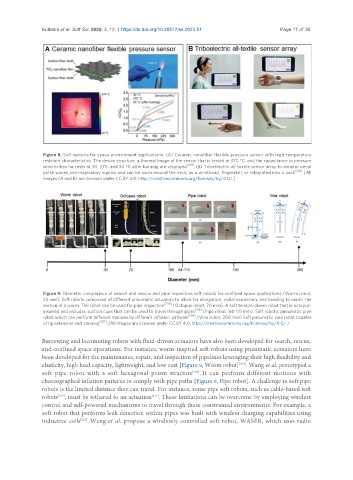
                Figure 8. Soft sensors for space environment applications. (A) Ceramic nanofiber flexible pressure sensor with high-temperature
                resistant characteristics. The device structure, a thermal image of the sensor that is tested at 370 °C, and the capacitance to pressure
                sensitivities for tests at 30, 370, and 30 °C after burning are  displayed [202] ; (B) Triboelectric all-textile sensor array to monitor aerial
                pulse waves and respiratory signals and can be worn around the neck, as a wristband, fingerstall, or integrated into a  sock [203] . [All
                images (A and B) are licensed under CC BY 4.0. http://creativecommons.org/licenses/by/4.0/.]


                Figure 9. Diameter comparison of search and rescue and pipe inspection soft robots for confined space applications (Worm robot,
                50 mm). Soft robots composed of different pneumatic actuators to allow for elongation, radial expansion, and bending to mimic the
                motion of a worm. The robot can be used for pipe inspection [208]  (Octopus robot, 70 mm). A soft tendon-driven robot that is octopus-
                inspired and includes suction cups that can be used to travel through pipes [216]  (Pipe robot, 84-115 mm). Soft robotic pneumatic pipe
                robot which can perform different motions by different inflation patterns [209] . (Vine robot, 200 mm) Soft pneumatic vine robot capable
                of tip extension and steering [207] . (All images are licensed under CC BY 4.0. http://creativecommons.org/licenses/by/4.0/.)

               Burrowing and locomoting robots with fluid-driven actuators have also been developed for search, rescue,
               and confined space operations. For instance, worm-inspired soft robots using pneumatic actuators have
               been developed for the maintenance, repair, and inspection of pipelines leveraging their high flexibility and
                                                                                  [208]
               elasticity, high load capacity, lightweight, and low cost [Figure 9, Worm robot] . Wang et al. prototyped a
               soft  pipe  robot  with  a  soft  hexagonal  prism  structure . It  can  perform  different  motions  with
                                                                  [209]
               choreographed inflation patterns to comply with pipe paths [Figure 9, Pipe robot]. A challenge to soft pipe
               robots is the limited distance they can travel. For instance, some pipe soft robots, such as cable-based soft
                     [210]
                                                    [211]
               robots , must be tethered to an actuation . These limitations can be overcome by employing wireless
               control and self-powered mechanisms to travel through these constrained environments. For example, a
               soft robot that performs leak detection within pipes was built with wireless charging capabilities using
               inductive coils . Wang et al. propose a wirelessly controlled soft robot, WASER, which uses radio
                            [212]

