


Page 101 - Read Online
P. 101
Page 22 of 35                        Kulkarni et al. Soft Sci. 2025, 5, 12  https://dx.doi.org/10.20517/ss.2023.51

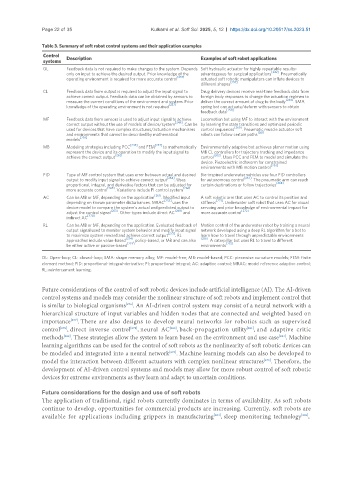
               Table 3. Summary of soft robot control systems and their application examples
                Control   Description                                Examples of soft robot applications
                systems
                OL     Feedback data is not required to make changes to the system. Depends  Soft hydraulic actuator for highly repeatable results-
                       only on input to achieve the desired output. Prior knowledge of the   advantageous for surgical applications [242] . Pneumatically
                                                             [257]
                       operating environment is required for more accurate control  actuated soft robotic manipulators can inflate devices to
                                                                     different shapes [257]
                CL     Feedback data from output is required to adjust the input signal to   Drug delivery devices receive real-time feedback data from
                       achieve correct output. Feedback data can be obtained by sensors to   foreign body responses to change the actuation regimen to
                       measure the current conditions of the environment and system. Prior   deliver the correct amount of drug to the body [244] . SMA
                       knowledge of the operating environment is not required [257]  spring bot can actuate/deform with sensors to obtain
                                                                     feedback data [258]
                MF     Feedback data from sensors is used to adjust input signal to achieve   Locomotion bot using MF to interact with the environment
                       correct output without the use of models of device/system [248] . Can be  by learning the state transitions and optimized periodic
                                                                                [260]
                       used for devices that have complex structures/actuation mechanisms   control sequences  . Pneumatic muscle actuator soft
                       and environments that cannot be described by mathematical   robots can follow certain paths [261]
                            [259]
                       models
                MB     Modeling strategies including PCC [245]  and FEM [247]  to mathematically  Environmentally adaptive bot achieves planar motion using
                       represent the device and its operation to modify the input signal to   MB CL controllers for trajectory tracking and impedance
                                        [262]                            [262]
                       achieve the correct output                    control  . Uses PCC and FEM to model and simulate the
                                                                     device. Piezoelectric inchworm for constrained
                                                                                            [263]
                                                                     environments with MB motion control
                PID    Type of MF control system that uses error between actual and desired  Bio-inspired underwater vehicles use four PID controllers
                                                         [264]                     [267]
                       output to modify input signal to achieve correct output  . Uses   for autonomous control  . The pneumatic arm can reach
                       proportional, integral, and derivative factors that can be adjusted for   certain destinations or follow trajectories [268]
                                     [265]                     [266]
                       more accurate control  . Variations include PI control system
                AC     Can be MB or MF, depending on the application [261] . Modified input   A soft robotic arm that uses AC to control its position and
                                                        [253]             [271]
                       depending on known parameter disturbances. MRAC   uses the   stiffness  . Underwater soft robot that uses AC for visual
                       device model to compare the system’s actual and predicted output to   servoing and prior knowledge of environmental impact for
                                      [253]                 [269]                 [272]
                       adjust the control signal  . Other types include direct AC   and   more accurate control
                               [270]
                       indirect AC
                RL     Can be MB or MF, depending on the application. Evaluated feedback of  Motion control of the underwater robot by training a neural
                       output signal used to monitor system behavior and modify input signal  network developed using a deep RL algorithm for a bot to
                       to maximize system reward and achieve correct output [273] . RL   learn how to travel through unpredictable environments
                       approaches include value-based [274] , policy-based, or MB and can also   [256] . A caterpillar bot uses RL to travel to different
                       be either active or passive-based [274]       environments [275]
               OL: Open-loop; CL: closed-loop; SMA: shape memory alloy; MF: model-free; MB: model-based; PCC: piecewise curvature models; FEM: finite
               element method; PID: proportional-integral-derivative; PI: proportional-integral; AC: adaptive control; MRAC: model reference adaptive control;
               RL: reinforcement learning.
               Future considerations of the control of soft robotic devices include artificial intelligence (AI). The AI-driven
               control systems and models may consider the nonlinear structure of soft robots and implement control that
               is similar to biological organisms . An AI-driven control system may consist of a neural network with a
                                           [276]
               hierarchical structure of input variables and hidden nodes that are connected and weighted based on
               importance . There are also designs to develop neural networks for robotics such as supervised
                         [277]
                     [278]
                                             [279]
                                                                                    [281]
                                                          [280]
               control , direct  inverse  control , neural  AC , back-propagation  utility , and  adaptive  critic
               methods . These strategies allow the system to learn based on the environment and use case . Machine
                                                                                               [283]
                      [282]
               learning algorithms can be used for the control of soft robots as the nonlinearity of soft robotic devices can
               be modeled and integrated into a neural network . Machine learning models can also be developed to
                                                          [276]
                                                                                          [276]
               model the interaction between different actuators with complex nonlinear structures . Therefore, the
               development of AI-driven control systems and models may allow for more robust control of soft robotic
               devices for extreme environments as they learn and adapt to uncertain conditions.
               Future considerations for the design and use of soft robots
               The application of traditional, rigid robots currently dominates in terms of availability. As soft robots
               continue to develop, opportunities for commercial products are increasing. Currently, soft robots are
               available for applications including grippers in manufacturing , sleep monitoring technology ,
                                                                                                       [285]
                                                                         [284]

