


Page 98 - Read Online
P. 98
Kulkarni et al. Soft Sci. 2025, 5, 12  https://dx.doi.org/10.20517/ss.2023.51   Page 19 of 35


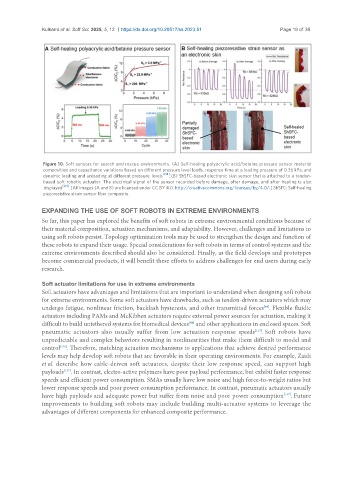
                Figure 10. Soft sensors for search and rescue environments. (A) Self-healing polyacrylic acid/betaine pressure sensor material
                composition and capacitance variations based on different pressure level loads, response time at a loading pressure of 0.36 kPa, and
                dynamic loading and unloading at different pressure  levels [218] ; (B) ShSFC-based electronic skin sensor that is attached to a tendon-
                based soft robotic actuator. The electrical signal of the sensor recorded before damage, after damage, and after healing is also
                displayed [219] . [All images (A and B) are licensed under CC BY 4.0. http://creativecommons.org/licenses/by/4.0/.] ShSFC: Self-healing
                piezoresistive strain sensor fiber composite.


               EXPANDING THE USE OF SOFT ROBOTS IN EXTREME ENVIRONMENTS
               So far, this paper has explored the benefits of soft robots in extreme environmental conditions because of
               their material composition, actuation mechanisms, and adaptability. However, challenges and limitations to
               using soft robots persist. Topology optimization tools may be used to strengthen the design and function of
               these robots to expand their usage. Special considerations for soft robots in terms of control systems and the
               extreme environments described should also be considered. Finally, as the field develops and prototypes
               become commercial products, it will benefit these efforts to address challenges for end users during early
               research.

               Soft actuator limitations for use in extreme environments
               Soft actuators have advantages and limitations that are important to understand when designing soft robots
               for extreme environments. Some soft actuators have drawbacks, such as tendon-driven actuators which may
               undergo fatigue, nonlinear friction, backlash hysteresis, and other transmitted forces . Flexible fluidic
                                                                                          [44]
               actuators including PAMs and McKibben actuators require external power sources for actuation, making it
               difficult to build untethered systems for biomedical devices  and other applications in enclosed spaces. Soft
                                                                 [44]
               pneumatic actuators also usually suffer from low actuation response speeds . Soft robots have
                                                                                       [137]
               unpredictable and complex behaviors resulting in nonlinearities that make them difficult to model and
                     [220]
               control . Therefore, matching actuation mechanisms to applications that achieve desired performance
               levels may help develop soft robots that are favorable in their operating environments. For example, Zaidi
               et al. describe how cable-driven soft actuators, despite their low response speed, can support high
               payloads . In contrast, electro-active polymers have poor payload performance, but exhibit faster response
                      [137]
               speeds and efficient power consumption. SMAs usually have low noise and high force-to-weight ratios but
               lower response speeds and poor power consumption performance. In contrast, pneumatic actuators usually
                                                                                                 [137]
               have high payloads and adequate power but suffer from noise and poor power consumption . Future
               improvements to building soft robots may include building multi-actuator systems to leverage the
               advantages of different components for enhanced composite performance.

