


Page 78 - Read Online
P. 78
Page 10 of 12                             Luo et al. Soft Sci 2024;4:7   https://dx.doi.org/10.20517/ss.2023.40

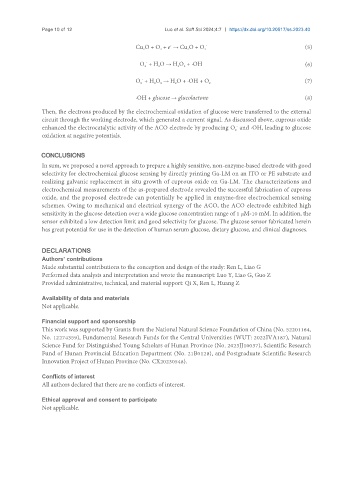
                                               Cu O + O  + e  → Cu O + O 2 -                             (5)
                                                          -
                                                       2
                                                                2
                                                 2
                                                O  + H O → H O  + ·OH                                   (6)
                                                  -
                                                  2
                                                             2
                                                               2
                                                      2
                                               O  + H O  → H O + ·OH + O 2                              (7)
                                                 -
                                                       2
                                                     2
                                                2
                                                            2
                                               ·OH + glucose → glucolactone                             (8)
               Then, the electrons produced by the electrochemical oxidation of glucose were transferred to the external
               circuit through the working electrode, which generated a current signal. As discussed above, cuprous oxide
               enhanced the electrocatalytic activity of the ACO electrode by producing O  and ·OH, leading to glucose
                                                                                 -
                                                                                2
               oxidation at negative potentials.
               CONCLUSIONS
               In sum, we proposed a novel approach to prepare a highly sensitive, non-enzyme-based electrode with good
               selectivity for electrochemical glucose sensing by directly printing Ga-LM on an ITO or PE substrate and
               realizing galvanic replacement in situ growth of cuprous oxide on Ga-LM. The characterizations and
               electrochemical measurements of the as-prepared electrode revealed the successful fabrication of cuprous
               oxide, and the proposed electrode can potentially be applied in enzyme-free electrochemical sensing
               schemes. Owing to mechanical and electrical synergy of the ACO, the ACO electrode exhibited high
               sensitivity in the glucose detection over a wide glucose concentration range of 1 μM-10 mM. In addition, the
               sensor exhibited a low detection limit and good selectivity for glucose. The glucose sensor fabricated herein
               has great potential for use in the detection of human serum glucose, dietary glucose, and clinical diagnoses.


               DECLARATIONS
               Authors’ contributions
               Made substantial contributions to the conception and design of the study: Ren L, Liao G
               Performed data analysis and interpretation and wrote the manuscript: Luo Y, Liao G, Guo Z
               Provided administrative, technical, and material support: Qi X, Ren L, Huang Z

               Availability of data and materials
               Not applicable.

               Financial support and sponsorship
               This work was supported by Grants from the National Natural Science Foundation of China (No. 52201164,
               No. 12274359), Fundamental Research Funds for the Central Universities (WUT: 2022IVA187), Natural
               Science Fund for Distinguished Young Scholars of Hunan Province (No. 2023JJ10037), Scientific Research
               Fund of Hunan Provincial Education Department (No. 21B0128), and Postgraduate Scientific Research
               Innovation Project of Hunan Province (No. CX20230548).


               Conflicts of interest
               All authors declared that there are no conflicts of interest.


               Ethical approval and consent to participate
               Not applicable.

