


Page 74 - Read Online
P. 74
Page 6 of 12                              Luo et al. Soft Sci 2024;4:7   https://dx.doi.org/10.20517/ss.2023.40


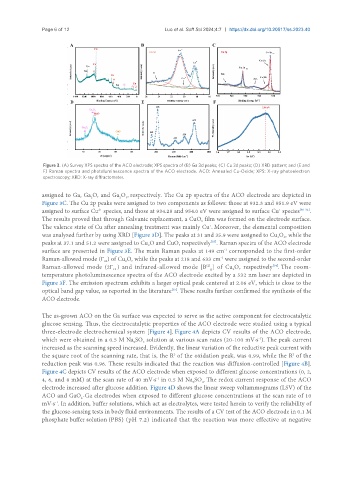
                Figure 3. (A) Survey XPS spectra of the ACO electrode; XPS spectra of (B) Ga 3d peaks; (C) Cu 3d peaks; (D) XRD pattern; and (E and
                F) Raman spectra and photoluminescence spectra of the ACO electrode. ACO: Annealed Cu-Oxide; XPS: X-ray photoelectron
                spectroscopy; XRD: X-ray diffractometer.

               assigned to Ga, Ga O, and Ga O , respectively. The Cu 2p spectra of the ACO electrode are depicted in
                                2
                                           3
                                         2
               Figure 3C. The Cu 2p peaks were assigned to two components as follows: those at 932.3 and 951.9 eV were
                                  2+
                                                                                               +
               assigned to surface Cu  species, and those at 934.28 and 954.0 eV were assigned to surface Cu  species [30-32] .
               The results proved that through Galvanic replacement, a CuO  film was formed on the electrode surface.
                                                                     x
               The valence state of Cu after annealing treatment was mainly Cu . Moreover, the elemental composition
                                                                        +
               was analyzed further by using XRD [Figure 3D]. The peaks at 31 and 35.9 were assigned to Cu O , while the
                                                                                                 3
                                                                                               4
               peaks at 37.1 and 51.2 were assigned to Cu O and CuO, respectively . Raman spectra of the ACO electrode
                                                                        [33]
                                                   2
                                                                             -1
               surface are presented in Figure 3E. The main Raman peaks at 149 cm  corresponded to the first-order
               Raman-allowed mode (Γ ) of Cu O, while the peaks at 218 and 633 cm  were assigned to the second-order
                                                                           -1
                                           2
                                    25
                                                                       (2)
                                                                                             [34]
               Raman-allowed mode (2Γ ) and infrared-allowed mode [B ] of Cu O, respectively . The room-
                                                                        g
                                       12-
                                                                               2
               temperature photoluminescence spectra of the ACO electrode excited by a 532 nm laser are depicted in
               Figure 3F. The emission spectrum exhibits a larger optical peak centered at 2.06 eV, which is close to the
                                                           [35]
               optical band gap value, as reported in the literature . These results further confirmed the synthesis of the
               ACO electrode.
               The as-grown ACO on the Ga surface was expected to serve as the active component for electrocatalytic
               glucose sensing. Thus, the electrocatalytic properties of the ACO electrode were studied using a typical
               three-electrode electrochemical system [Figure 4]. Figure 4A depicts CV results of the ACO electrode,
               which were obtained in a 0.5 M Na SO  solution at various scan rates (20-100 mV·s ). The peak current
                                                                                        -1
                                              2
                                                 4
               increased as the scanning speed increased. Evidently, the linear variation of the reductive peak current with
                                                                                                    2
               the square root of the scanning rate, that is, the R  of the oxidation peak, was 0.99, while the R  of the
                                                            2
               reduction peak was 0.96. These results indicated that the reaction was diffusion-controlled [Figure 4B].
               Figure 4C depicts CV results of the ACO electrode when exposed to different glucose concentrations (0, 2,
               4, 6, and 8 mM) at the scan rate of 40 mV·s  in 0.5 M Na SO . The redox current response of the ACO
                                                      -1
                                                                     4
                                                                  2
               electrode increased after glucose addition. Figure 4D shows the linear sweep voltammograms (LSV) of the
               ACO and GaO -Ga electrodes when exposed to different glucose concentrations at the scan rate of 10
                            x
               mV·s . In addition, buffer solutions, which act as electrolytes, were tested herein to verify the reliability of
                    -1
               the glucose-sensing tests in body fluid environments. The results of a CV test of the ACO electrode in 0.1 M
               phosphate buffer solution (PBS) (pH 7.2) indicated that the reaction was more effective at negative

