


Page 77 - Read Online
P. 77
Luo et al. Soft Sci 2024;4:7   https://dx.doi.org/10.20517/ss.2023.40            Page 9 of 12

               Table 1. Comparison of behavior of flexible sensors based on the ACO electrode with those of non-enzymatic glucose sensors based
               on other reported materials

                Materials     Electrode fabrication           Limit of   Sensitivity   Applied   Flexibility Ref.
                                                                             -1
                                                              detection   µA·mM ·cm -2  potential (V)
                                                              ( µM)
                Si-CuO core-shell   MPI method; E evaporator                           740  2,324.09  1.0 (vs.  ×  [40]
                nanowire                                                            Ag/AgCl)
                Cu O/TiO      A JDF-05 benchtop machine at an applied  14.4  1.0366  0.1 (vs.   ×    [41]
                 2    2
                              voltage of 21 kV and a propulsion rate of             Hg/HgO)
                              1.0 mL/h; 600 °C
                CuO           450 °C at atmospheric pressure; NH ; 650 °C  59  263  0.54 (n/A)  ×    [42]
                                                     3
                Cu/Cu O       700 °C                          0.31       621.12     0.4 (n/A)  ×     [43]
                    2
                                                                               6
                Au@CuO/V CT x  HF aqueous, argon, vigorous stirring, low   5  1.124 × 10  0.45 (vs. SCE) ×  [44]
                       2
                              temperature
                MXene/NiCo-LDH  HF, vacuum, centrifugation, high temperature  0.53  67.75  0.45 (vs. SCE) ×  [45]
                Ti C T -Cu O  Centrifugation, vacuum, HF, high temperature  10  11.061  0.6 (vs.   ×  [46]
                      2
                 3 2 x
                                                                                    Ag/AgCl)
                Pt/MXene/CH/Pt  HCl, high temperature, lithography  29.15  3.43     0.2 (vs.   √     [47]
                                                                                    Ag/AgCl)
                ACO           Room temperature                1          0.87       -0.4 (vs.   √    This
                                                                                    Ag/AgCl)         work
               ACO: Annealed Cu-Oxide; CH: conductive hydrogel; HF: hydrofluoric acid ; LDH: layered double hydroxide ; MPI: micro-propulsive injection; SCE:
               saturated calomel electrode.


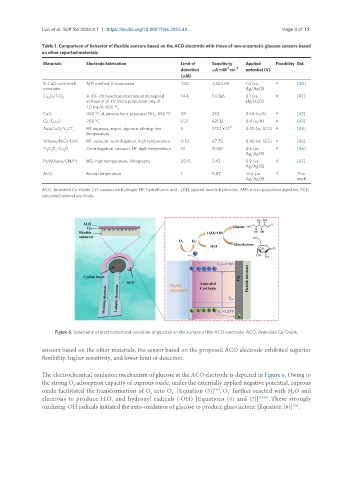
                    Figure 6. Schematic of electrochemical oxidation of glucose on the surface of the ACO electrode. ACO: Annealed Cu-Oxide.

               sensors based on the other materials, the sensor based on the proposed ACO electrode exhibited superior
               flexibility, higher sensitivity, and lower limit of detection.


               The electrochemical oxidation mechanism of glucose at the ACO electrode is depicted in Figure 6. Owing to
               the strong O  adsorption capacity of cuprous oxide, under the externally applied negative potential, cuprous
                          2
               oxide facilitated the transformation of O  into O  [Equation (5)] . O  further reacted with H O and
                                                                         [36]
                                                                              -
                                                           -
                                                           2
                                                                                                    2
                                                    2
                                                                              2
               electrons to produce H O  and hydroxyl radicals (·OH) [Equations (6) and (7)] [37,38] . These strongly
                                     2
                                       2
                                                                                                    [39]
               oxidizing ·OH radicals initiated the auto-oxidation of glucose to produce glucolactone [Equation (8)] .

