


Page 95 - Read Online
P. 95
Wang et al. Soft Sci 2024;4:32  https://dx.doi.org/10.20517/ss.2024.15          Page 19 of 27


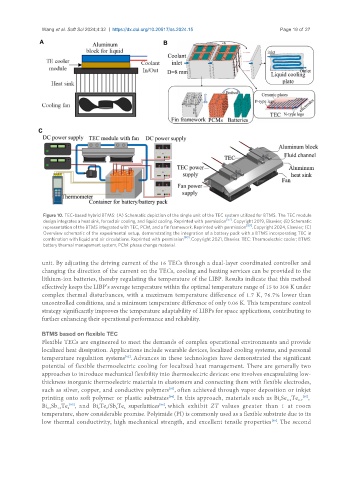
                Figure 10. TEC-based hybrid BTMS: (A) Schematic depiction of the single unit of the TEC system utilized for BTMS. The TEC module
                design integrates a heat sink, forced air cooling, and liquid cooling. Reprinted with permission [57] . Copyright 2019, Elsevier; (B) Schematic
                representation of the BTMS integrated with TEC, PCM, and a fin framework. Reprinted with permission [89] . Copyright 2024, Elsevier; (C)
                Overview schematic of the experimental setup, demonstrating the integration of a battery pack with a BTMS incorporating TEC in
                combination with liquid and air circulations. Reprinted with permission [90] . Copyright 2021, Elsevier. TEC: Thermoelectric cooler; BTMS:
                battery thermal management system; PCM: phase change material.

               unit. By adjusting the driving current of the 16 TECs through a dual-layer coordinated controller and
               changing the direction of the current on the TECs, cooling and heating services can be provided to the
               lithium-ion batteries, thereby regulating the temperature of the LIBP. Results indicate that this method
               effectively keeps the LIBP’s average temperature within the optimal temperature range of 15 to 308 K under
               complex thermal disturbances, with a maximum temperature difference of 1.7 K, 76.7% lower than
               uncontrolled conditions, and a minimum temperature difference of only 0.06 K. This temperature control
               strategy significantly improves the temperature adaptability of LIBPs for space applications, contributing to
               further enhancing their operational performance and reliability.


               BTMS based on flexible TEC
               Flexible TECs are engineered to meet the demands of complex operational environments and provide
               localized heat dissipation. Applications include wearable devices, localized cooling systems, and personal
                                           [92]
               temperature regulation systems . Advances in these technologies have demonstrated the significant
               potential of flexible thermoelectric cooling for localized heat management. There are generally two
               approaches to introduce mechanical flexibility into thermoelectric devices: one involves encapsulating low-
               thickness inorganic thermoelectric materials in elastomers and connecting them with flexible electrodes,
               such as silver, copper, and conductive polymers , often achieved through vapor deposition or inkjet
                                                          [93]
               printing onto soft polymer or plastic substrates . In this approach, materials such as Bi Se Te 2.7 [95] ,
                                                          [94]
                                                                                               2
                                                                                                  0.3
                        [95]
               Bi Sb Te ,  and  Bi Te /Sb Te   superlattices , which  exhibit  ZT  values  greater  than  1  at  room
                                                       [96]
                                           3
                                        2
                    1.5
                 0.5
                        3
                                     3
                                  2
               temperature, show considerable promise. Polyimide (PI) is commonly used as a flexible substrate due to its
               low thermal conductivity, high mechanical strength, and excellent tensile properties . The second
                                                                                             [95]

