


Page 93 - Read Online
P. 93
Wang et al. Soft Sci 2024;4:32  https://dx.doi.org/10.20517/ss.2024.15          Page 17 of 27


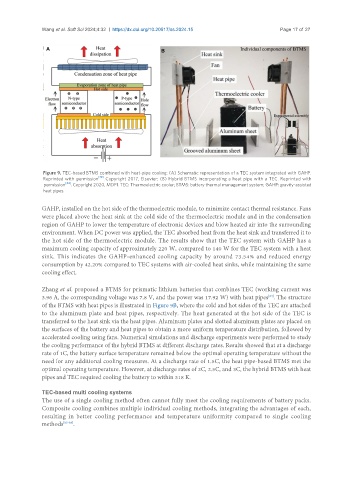
                Figure 9. TEC-based BTMS combined with heat-pipe cooling: (A) Schematic representation of a TEC system integrated with GAHP.
                Reprinted with  permission [79] . Copyright 2017, Elsevier; (B) Hybrid BTMS incorporating a heat pipe with a TEC. Reprinted with
                permission [84] . Copyright 2020, MDPI. TEC: Thermoelectric cooler; BTMS: battery thermal management system; GAHP: gravity-assisted
                heat pipes.

               GAHP, installed on the hot side of the thermoelectric module, to minimize contact thermal resistance. Fans
               were placed above the heat sink at the cold side of the thermoelectric module and in the condensation
               region of GAHP to lower the temperature of electronic devices and blow heated air into the surrounding
               environment. When DC power was applied, the TEC absorbed heat from the heat sink and transferred it to
               the hot side of the thermoelectric module. The results show that the TEC system with GAHP has a
               maximum cooling capacity of approximately 220 W, compared to 140 W for the TEC system with a heat
               sink. This indicates the GAHP-enhanced cooling capacity by around 73.54% and reduced energy
               consumption by 42.20% compared to TEC systems with air-cooled heat sinks, while maintaining the same
               cooling effect.


               Zhang et al. proposed a BTMS for prismatic lithium batteries that combines TEC (working current was
               3.96 A, the corresponding voltage was 7.8 V, and the power was 17.92 W) with heat pipes . The structure
                                                                                           [84]
               of the BTMS with heat pipes is illustrated in Figure 9B, where the cold and hot sides of the TEC are attached
               to the aluminum plate and heat pipes, respectively. The heat generated at the hot side of the TEC is
               transferred to the heat sink via the heat pipes. Aluminum plates and slotted aluminum plates are placed on
               the surfaces of the battery and heat pipes to obtain a more uniform temperature distribution, followed by
               accelerated cooling using fans. Numerical simulations and discharge experiments were performed to study
               the cooling performance of the hybrid BTMS at different discharge rates. Results showed that at a discharge
               rate of 1C, the battery surface temperature remained below the optimal operating temperature without the
               need for any additional cooling measures. At a discharge rate of 1.5C, the heat pipe-based BTMS met the
               optimal operating temperature. However, at discharge rates of 2C, 2.5C, and 3C, the hybrid BTMS with heat
               pipes and TEC required cooling the battery to within 318 K.


               TEC-based multi cooling systems
               The use of a single cooling method often cannot fully meet the cooling requirements of battery packs.
               Composite cooling combines multiple individual cooling methods, integrating the advantages of each,
               resulting in better cooling performance and temperature uniformity compared to single cooling
               methods [85-88] .

