


Page 62 - Read Online
P. 62
Page 4 of 9                                Ao et al. Soft Sci 2024;4:3  https://dx.doi.org/10.20517/ss.2023.34


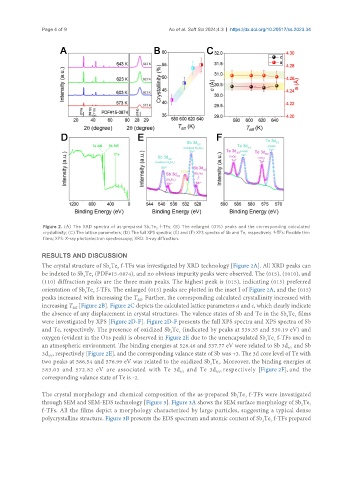
                Figure 2. (A) The XRD spectra of as-prepared Sb Te  f-TFs; (B) The enlarged (015) peaks and the corresponding calculated
                                                      3
                                                   2
                crystallinity; (C) The lattice parameters; (D) The full XPS spectra; (E) and (F) XPS spectra of Sb and Te, respectively. f-TFs: Flexible thin
                films; XPS: X-ray photoelectron spectroscopy; XRD: X-ray diffraction.
               RESULTS AND DISCUSSION
               The crystal structure of Sb Te  f-TFs was investigated by XRD technology [Figure 2A]. All XRD peaks can
                                      2
                                         3
               be indexed to Sb Te  (PDF#15-0874), and no obvious impurity peaks were observed. The (015), (1010), and
                             2
                                3
               (110) diffraction peaks are the three main peaks. The highest peak is (015), indicating (015) preferred
               orientation of Sb Te  f-TFs. The enlarged (015) peaks are plotted in the inset I of Figure 2A, and the (015)
                              2
                                3
               peaks increased with increasing the T . Further, the corresponding calculated crystallinity increased with
                                               diff
               increasing T  [Figure 2B]. Figure 2C depicts the calculated lattice parameters a and c, which clearly indicate
                          diff
               the absence of any displacement in crystal structures. The valence states of Sb and Te in the Sb Te  films
                                                                                                  2
                                                                                                    3
               were investigated by XPS [Figure 2D-F]. Figure 2D-F presents the full XPS spectra and XPS spectra of Sb
               and Te, respectively. The presence of oxidized Sb Te  (indicated by peaks at 539.35 and 530.19 eV) and
                                                             3
                                                           2
               oxygen (evident in the O1s peak) is observed in Figure 2E due to the unencapsulated Sb Te  f-TFs used in
                                                                                             3
                                                                                           2
               an atmospheric environment. The binding energies at 528.46 and 537.77 eV were related to Sb 3d  and Sb
                                                                                                  5/2
               3d , respectively [Figure 2E], and the corresponding valance state of Sb was +3. The 3d core level of Te with
                 3/2
               two peaks at 586.54 and 576.99 eV was related to the oxidized Sb Te . Moreover, the binding energies at
                                                                        2
                                                                           3
               583.03  and  572.82  eV  are  associated  with  Te  3d   and  Te  3d , respectively  [Figure 2F], and  the
                                                                          5/2
                                                              3/2
               corresponding valance state of Te is -2.
               The crystal morphology and chemical composition of the as-prepared Sb Te  f-TFs were investigated
                                                                                 2
                                                                                    3
               through SEM and SEM-EDS technology [Figure 3]. Figure 3A shows the SEM surface morphology of Sb Te
                                                                                                         3
                                                                                                       2
               f-TFs. All the films depict a morphology characterized by large particles, suggesting a typical dense
               polycrystalline structure. Figure 3B presents the EDS spectrum and atomic content of Sb Te  f-TFs prepared
                                                                                         2
                                                                                            3

