


Page 64 - Read Online
P. 64
Page 6 of 9                                Ao et al. Soft Sci 2024;4:3  https://dx.doi.org/10.20517/ss.2023.34


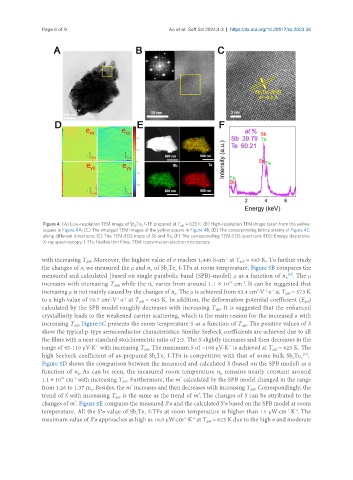
                Figure 4. (A) Low-resolution TEM image of Sb Te  f-TF prepared at T  = 623 K; (B) High-resolution TEM image taken from the yellow
                                              2
                                                              diff
                                                 3
                square in Figure 4A; (C) The enlarged TEM images of the yellow square in Figure 4B; (D) The corresponding lattice strains of Figure 4C
                along different directions; (E) The TEM-EDS maps of Sb and Te; (F) The corresponding TEM-EDS spectrum. EDS: Energy dispersive
                X-ray spectroscopy; f-TFs: flexible thin films; TEM: transmission electron microscopy.
               with increasing T . Moreover, the highest value of σ reaches 1,440 S·cm  at T  = 643 K. To further study
                                                                             -1
                              diff
                                                                                  diff
               the changes of σ, we measured the μ and n  of Sb Te  f-TFs at room temperature. Figure 5B compares the
                                                            3
                                                    h
                                                         2
               measured and calculated [based on single parabolic band (SPB)-model] μ as a function of n h [33] . The μ
                                                                                   -3
                                                                              19
               increases with increasing T , while the n  varies from around 1.1 × 10  cm . It can be suggested that
                                       diff
                                                    h
               increasing μ is not mainly caused by the changes of n . The μ is achieved from 63.4 cm ·V ·s  at T  = 573 K
                                                                                        2
                                                                                          -1 -1
                                                            h
                                                                                                 diff
               to a high value of 79.7 cm ·V ·s  at T  = 643 K. In addition, the deformation potential coefficient (E )
                                        -1 -1
                                      2
                                                                                                        def
                                                diff
               calculated by the SPB model roughly decreases with increasing T . It is suggested that the enhanced
                                                                          diff
               crystallinity leads to the weakened carrier scattering, which is the main reason for the increased σ with
               increasing T . Figure 5C presents the room temperature S as a function of T . The positive values of S
                                                                                   diff
                          diff
               show the typical p-type semiconductor characteristics. Similar Seebeck coefficients are achieved due to all
               the films with a near standard stoichiometric ratio of 2:3. The S slightly increases and then decreases in the
                                                                              -1
               range of 95-110 μV·K  with increasing T . The maximum S of ~106 μV·K  is achieved at T  = 623 K. The
                                 -1
                                                  diff
                                                                                             diff
                                                                                                       [34]
               high Seebeck coefficient of as-prepared Sb Te  f-TFs is competitive with that of some bulk Sb Te .
                                                     2
                                                        3
                                                                                                      3
                                                                                                    2
               Figure 5D shows the comparison between the measured and calculated S (based on the SPB model) as a
               function of n . As can be seen, the measured room temperature n  remains nearly constant around
                                                                           h
                           h
               1.1 × 10  cm  with increasing T . Furthermore, the m  calculated by the SPB model changed in the range
                      20
                                                              *
                          -3
                                          diff
                                             *
               from 1.26 to 1.37 m . Besides, the m  increases and then decreases with increasing T . Correspondingly, the
                                0
                                                                                     diff
               trend of S with increasing T  is the same as the trend of m . The changes of S can be attributed to the
                                                                    *
                                        diff
                                                          2
               changes of m . Figure 5E compares the measured S σ and the calculated S σ based on the SPB model at room
                          *
                                                                            2
                                                                                                     -2
               temperature. All the S σ value of Sb Te  f-TFs at room temperature is higher than 11 μW·cm ·K . The
                                                                                                  -1
                                   2
                                               2
                                                  3
               maximum value of S σ approaches as high as 16.0 μW·cm ·K  at T  = 623 K due to the high σ and moderate
                                                                  -2
                                                               -1
                                2
                                                                       diff

