


Page 65 - Read Online
P. 65
Ao et al. Soft Sci 2024;4:3  https://dx.doi.org/10.20517/ss.2023.34              Page 7 of 9


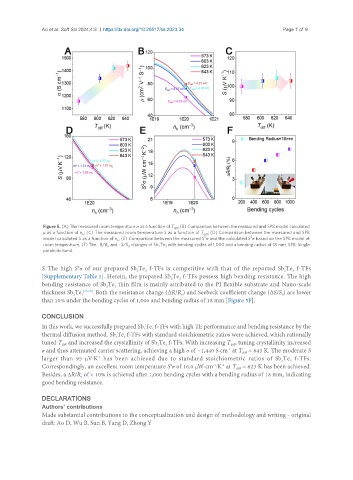
                Figure 5. (A) The measured room temperature σ as a function of T ; (B) Comparison between the measured and SPB model calculated
                                                            diff
                μ as a function of n ; (C) The measured room temperature S as a function of T ; (D) Comparison between the measured and SPB
                                                                      diff
                             h
                                                                      2
                                                                                     2
                model calculated S as a function of n ; (E) Comparison between the measured S σ and the calculated S σ based on the SPB model at
                                         h
                room temperature; (F) The  R/R  and  S/S  changes of Sb Te  with bending cycles of 1,000 and a bending radius of 18 mm. SPB: Single
                                     0      0         2  3
                parabolic band.
               S. The high S σ of our prepared Sb Te  f-TFs is competitive with that of the reported Sb Te  f-TFs
                           2
                                                  3
                                                                                                 2
                                                                                                    3
                                               2
               [Supplementary Table 1]. Herein, the prepared Sb Te  f-TFs possess high bending resistance. The high
                                                             3
                                                           2
               bending resistance of Sb Te  thin film is mainly attributed to the PI flexible substrate and Nano-scale
                                        3
                                     2
               thickness Sb Te 3 [35,36] . Both the resistance change (∆R/R ) and Seebeck coefficient change (∆S/S ) are lower
                                                              0
                                                                                                0
                          2
               than 10% under the bending cycles of 1,000 and bending radius of 18 mm [Figure 5F].
               CONCLUSION
               In this work, we successfully prepared Sb Te  f-TFs with high TE performance and bending resistance by the
                                                  2
                                                    3
               thermal diffusion method. Sb Te  f-TFs with standard stoichiometric ratios were achieved, which rationally
                                        2
                                           3
               tuned T  and increased the crystallinity of Sb Te  f-TFs. With increasing T , tuning crystallinity increased
                                                         3
                                                                               diff
                      diff
                                                      2
               σ and thus attenuated carrier scattering, achieving a high σ of ~1,440 S·cm  at T  = 643 K. The moderate S
                                                                              -1
                                                                                   diff
               larger  than  95  μV·K   has  been  achieved  due  to  standard  stoichiometric  ratios  of  Sb Te   f-TFs.
                                  -1
                                                                                                2
                                                                                                   3
               Correspondingly, an excellent room temperature S σ of 16.0 μW·cm ·K  at T  = 623 K has been achieved.
                                                                            -2
                                                          2
                                                                         -1
                                                                                 diff
               Besides, a ΔR/R  of < 10% is achieved after 1,000 bending cycles with a bending radius of 18 mm, indicating
                            0
               good bending resistance.
               DECLARATIONS
               Authors’ contributions
               Made substantial contributions to the conceptualization and design of methodology and writing - original
               draft: Ao D, Wu B, Sun B, Yang D, Zhong Y

