


Page 41 - Read Online
P. 41
Wang et al. Soft Sci 2023;3:34  https://dx.doi.org/10.20517/ss.2023.25           Page 9 of 26

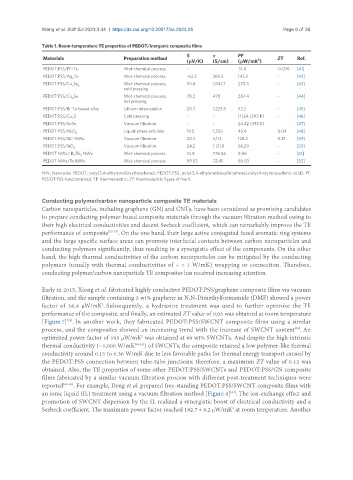
               Table 1. Room-temperature TE properties of PEDOT/inorganic composite films
                                                                S        σ       PF
                Materials                  Preparation method                           2      ZT    Ref.
                                                                (μV/K)   (S/cm)  (μW/mK )
                PEDOT:PSS/PF-Te            Wet-chemical process  ~       ~       51.4          0.076  [41]
                PEDOT:PSS/Ag Te            Wet-chemical process  -62.3   369.3   143.3         ~     [42]
                         2
                PEDOT:PSS/Cu Se            Wet-chemical process,  50.8   1,047.1  270.3        ~     [43]
                         x  y
                                           cold pressing
                PEDOT:PSS/Cu Se            Wet-chemical process,   78.2  470     287.4         ~     [44]
                         2
                                           hot pressing
                PEDOT:PSS/Bi-Te-based alloy  Lithium intercalation  20.7  1,223.8  52.3        ~     [45]
                PEDOT:PSS/Cu S             Cold pressing        ~        ~       111.54 (393 K)  ~   [46]
                         2
                PEDOT:PSS/SnSe             Vacuum filtration    ~        ~       24.42 (353 K)       [47]
                PEDOT:PSS/MoS              Liquid-phase exfoliate   19.5  1,250  45.6          0.04  [48]
                           2
                PEDOT:PSS/SiC-NWs          Vacuum filtration    20.3     3,113   128.3         0.17  [49]
                PEDOT:PSS/SiO              Vacuum filtration    24.2     1,131.9  66.29        ~     [50]
                          2
                PEDOT NWs/ Bi Te  NWs      Wet-chemical process  10.8    776.52  9.06          ~     [51]
                          2
                            3
                PEDOT NWs/Te NWs           Wet-chemical process  89.52   72.41   58.03         ~     [52]
               NW: Nanowire; PEDOT: poly(3,4-ethylenedioxythiophene); PEDOT:PSS: poly(3,4-ethylenedioxythiophene):poly(4-styrenesulfonic acid); PF:
               PEDOT:PSS-functionalized; TE: thermoelectric; ZT: thermoelectric figure of merit.


               Conducting polymer/carbon nanoparticle composite TE materials
               Carbon nanoparticles, including graphene (GN) and CNTs, have been considered as promising candidates
               to prepare conducting polymer-based composite materials through the vacuum filtration method owing to
               their high electrical conductivities and decent Seebeck coefficient, which can remarkably improve the TE
               performance of composite [55-57] . On the one hand, their large active conjugated fused aromatic ring systems
               and the large specific surface areas can promote interfacial contacts between carbon nanoparticles and
               conducting polymers significantly, thus resulting in a synergistic effect of the components. On the other
               hand, the high thermal conductivities of the carbon nanoparticles can be mitigated by the conducting
               polymers (usually with thermal conductivities of ~ < 1 W/mK) wrapping or connection. Therefore,
               conducting polymer/carbon nanoparticle TE composites has received increasing attention.

               Early in 2015, Xiong et al. fabricated highly conductive PEDOT:PSS/graphene composite films via vacuum
               filtration, and the sample containing 3 wt% graphene in N,N-Dimethylformamide (DMF) showed a power
                                   2
               factor of 38.6  μW/mK . Subsequently, a hydrazine treatment was used to further optimize the TE
               performance of the composite, and finally, an estimated ZT value of 0.05 was obtained at room temperature
               [Figure 7] . In another work, they fabricated PEDOT:PSS/SWCNT composite films using a similar
                        [58]
               process, and the composites showed an increasing trend with the increase of SWCNT content . An
                                                                                                    [59]
               optimized power factor of 105 μW/mK  was obtained at 60 wt% SWCNTs. And despite the high intrinsic
                                                 2
               thermal conductivity (~1,000 W/mK [60,61] ) of SWCNTs, the composite retained a low polymer-like thermal
               conductivity around 0.15 to 0.36 W/mK due to less favorable paths for thermal energy transport caused by
               the PEDOT:PSS connection between tube-tube junctions; therefore, a maximum ZT value of 0.12 was
               obtained. Also, the TE properties of some other PEDOT:PSS/SWCNTs and PEDOT:PSS/GN composite
               films fabricated by a similar vacuum filtration process with different post-treatment techniques were
               reported [62-65] . For example, Deng et al. prepared free-standing PEDOT:PSS/SWCNT composite films with
               an ionic liquid (IL) treatment using a vacuum filtration method [Figure 8] . The ion-exchange effect and
                                                                               [64]
               promotion of SWCNT dispersion by the IL realized a synergistic boost of electrical conductivity and a
               Seebeck coefficient. The maximum power factor reached 182.7 ± 9.2 μW/mK  at room temperature. Another
                                                                               2

