


Page 44 - Read Online
P. 44
Page 12 of 26                           Wang et al. Soft Sci 2023;3:34  https://dx.doi.org/10.20517/ss.2023.25


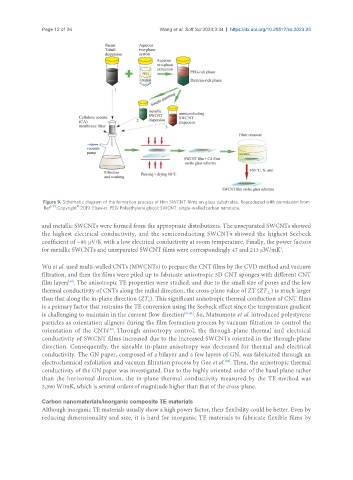
                Figure 9. Schematic diagram of the formation process of thin SWCNT films on glass substrates. Reproduced with permission from
                           ©
                Ref [79] . Copyright  2019. Elsevier. PEG: Polyethylene glycol; SWCNT: single-walled carbon nanotube.

               and metallic SWCNTs were formed from the appropriate distributions. The unseparated SWCNTs showed
               the highest electrical conductivity, and the semiconducting SWCNTs showed the highest Seebeck
               coefficient of ~80 μV/K with a low electrical conductivity at room temperature. Finally, the power factors
                                                                                                2
               for metallic SWCNTs and unseparated SWCNT films were correspondingly 47 and 213 μW/mK .
               Wu et al. used multi-walled CNTs (MWCNTs) to prepare the CNT films by the CVD method and vacuum
               filtration, and then the films were piled up to fabricate anisotropic 3D CNT sponges with different CNT
               film layers . The anisotropic TE properties were studied, and due to the small size of pores and the low
                        [80]
               thermal conductivity of CNTs along the radial direction, the cross-plane value of ZT (ZT ) is much larger
                                                                                           ⊥
               than that along the in-plane direction (ZT ). This significant anisotropic thermal conduction of CNT films
                                                   //
               is a primary factor that restrains the TE conversion using the Seebeck effect since the temperature gradient
               is challenging to maintain in the current flow direction [81,82] . So, Matsumoto et al. introduced polystyrene
               particles as orientation aligners during the film formation process by vacuum filtration to control the
               orientation of the CNTs . Through anisotropy control, the through-plane thermal and electrical
                                      [82]
               conductivity of SWCNT films increased due to the increased SWCNTs oriented in the through-plane
               direction. Consequently, the sizeable in-plane anisotropy was decreased for thermal and electrical
               conductivity. The GN paper, composed of a bilayer and a few layers of GN, was fabricated through an
                                                                             [83]
               electrochemical exfoliation and vacuum filtration process by Gee et al. . Then, the anisotropic thermal
               conductivity of the GN paper was investigated. Due to the highly oriented order of the basal plane rather
               than the horizontal direction, the in-plane thermal conductivity measured by the TE method was
               3,390 W/mK, which is several orders of magnitude higher than that of the cross-plane.


               Carbon nanomaterials/inorganic composite TE materials
               Although inorganic TE materials usually show a high power factor, their flexibility could be better. Even by
               reducing dimensionality and size, it is hard for inorganic TE materials to fabricate flexible films by

