


Page 40 - Read Online
P. 40
Page 8 of 26                            Wang et al. Soft Sci 2023;3:34  https://dx.doi.org/10.20517/ss.2023.25


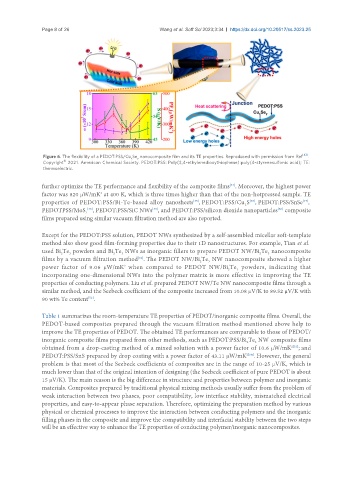
                Figure 6. The flexibility of a PEDOT:PSS/Cu Se  nanocomposite film and its TE properties. Reproduced with permission from  Ref [43] .
                                             x  y
                       ©
                Copyright  2021. American Chemical Society. PEDOT:PSS: Poly(3,4-ethylenedioxythiophene):poly(4-styrenesulfonic acid); TE:
                thermoelectric.
               further optimize the TE performance and flexibility of the composite films . Moreover, the highest power
                                                                              [44]
               factor was 820 μW/mK  at 400 K, which is three times higher than that of the non-hotpressed sample. TE
                                   2
                                                                                     [46]
               properties of PEDOT:PSS/Bi-Te-based alloy nanosheets , PEDOT:PSS/Cu S , PEDOT:PSS/SnSe ,
                                                                                                       [47]
                                                                  [45]
                                                                                    2
               PEDOTPSS/MoS , PEDOT:PSS/SiC NWs , and PEDOT:PSS/silicon dioxide nanoparticles  composite
                              [48]
                                                    [49]
                                                                                               [50]
                              2
               films prepared using similar vacuum filtration method are also reported.
               Except for the PEDOT:PSS solution, PEDOT NWs synthesized by a self-assembled micellar soft-template
               method also show good film-forming properties due to their 1D nanostructures. For example, Tian et al.
               used Bi Te  powders and Bi Te  NWs as inorganic fillers to prepare PEDOT NW/Bi Te  nanocomposite
                      2
                                                                                           3
                                       2
                                          3
                        3
                                                                                         2
                                                [51]
               films by a vacuum filtration method . The PEDOT NW/Bi Te  NW nanocomposite showed a higher
                                                                       3
                                                                    2
               power  factor  of  9.06  µW/mK   when  compared  to  PEDOT  NW/Bi Te   powders,  indicating  that
                                           2
                                                                              2
                                                                                 3
               incorporating one-dimensional NWs into the polymer matrix is more effective in improving the TE
               properties of conducting polymers. Liu et al. prepared PEDOT NW/Te NW nanocomposite films through a
               similar method, and the Seebeck coefficient of the composite increased from 10.08 µV/K to 89.52 µV/K with
                               [52]
               90 wt% Te content .
               Table 1 summarizes the room-temperature TE properties of PEDOT/inorganic composite films. Overall, the
               PEDOT-based composites prepared through the vacuum filtration method mentioned above help to
               improve the TE properties of PEDOT. The obtained TE performances are comparable to those of PEDOT/
               inorganic composite films prepared from other methods, such as PEDOT:PSS/Bi Te  NW composite films
                                                                                    2
                                                                                       3
               obtained from a drop-casting method of a mixed solution with a power factor of 10.6 μW/mK ; and
                                                                                                   2[53]
               PEDOT:PSS/SnS prepared by drop coating with a power factor of 43.11 μW/mK . However, the general
                                                                                    2[54]
               problem is that most of the Seebeck coefficients of composites are in the range of 10-25 μV/K, which is
               much lower than that of the original intention of designing (the Seebeck coefficient of pure PEDOT is about
               15 μV/K). The main reason is the big difference in structure and properties between polymer and inorganic
               materials. Composites prepared by traditional physical mixing methods usually suffer from the problem of
               weak interaction between two phases, poor compatibility, low interface stability, mismatched electrical
               properties, and easy-to-appear phase separation. Therefore, optimizing the preparation method by various
               physical or chemical processes to improve the interaction between conducting polymers and the inorganic
               filling phases in the composite and improve the compatibility and interfacial stability between the two steps
               will be an effective way to enhance the TE properties of conducting polymer/inorganic nanocomposites.

