


Page 35 - Read Online
P. 35
Wang et al. Soft Sci 2023;3:34  https://dx.doi.org/10.20517/ss.2023.25           Page 3 of 26


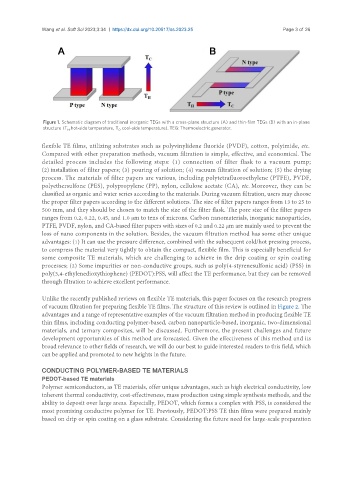
                Figure 1. Schematic diagram of traditional inorganic TEGs with a cross-plane structure (A) and thin-film TEGs (B) with an in-plane
                structure (T , hot-side temperature, T , cool-side temperature). TEG: Thermoelectric generator.
                        H                C

               flexible TE films, utilizing substrates such as polyvinylidene fluoride (PVDF), cotton, polyimide, etc.
               Compared with other preparation methods, vacuum filtration is simple, effective, and economical. The
               detailed process includes the following steps: (1) connection of filter flask to a vacuum pump;
               (2) installation of filter papers; (3) pouring of solution; (4) vacuum filtration of solution; (5) the drying
               process. The materials of filter papers are various, including polytetrafluoroethylene (PTFE), PVDF,
               polyethersulfone (PES), polypropylene (PP), nylon, cellulose acetate (CA), etc. Moreover, they can be
               classified as organic and water series according to the materials. During vacuum filtration, users may choose
               the proper filter papers according to the different solutions. The size of filter papers ranges from 13 to 25 to
               500 mm, and they should be chosen to match the size of the filter flask. The pore size of the filter papers
               ranges from 0.2, 0.22, 0.45, and 1.0 μm to tens of microns. Carbon nanomaterials, inorganic nanoparticles,
               PTFE, PVDF, nylon, and CA-based filter papers with sizes of 0.2 and 0.22 μm are mainly used to prevent the
               loss of nano components in the solution. Besides, the vacuum filtration method has some other unique
               advantages: (1) It can use the pressure difference, combined with the subsequent cold/hot pressing process,
               to compress the material very tightly to obtain the compact, flexible film. This is especially beneficial for
               some composite TE materials, which are challenging to achieve in the drip coating or spin coating
               processes; (2) Some impurities or non-conductive groups, such as poly(4-styrenesulfonic acid) (PSS) in
               poly(3,4-ethylenedioxythiophene) (PEDOT):PSS, will affect the TE performance, but they can be removed
               through filtration to achieve excellent performance.


               Unlike the recently published reviews on flexible TE materials, this paper focuses on the research progress
               of vacuum filtration for preparing flexible TE films. The structure of this review is outlined in Figure 2. The
               advantages and a range of representative examples of the vacuum filtration method in producing flexible TE
               thin films, including conducting polymer-based, carbon nanoparticle-based, inorganic, two-dimensional
               materials, and ternary composites, will be discussed. Furthermore, the present challenges and future
               development opportunities of this method are forecasted. Given the effectiveness of this method and its
               broad relevance to other fields of research, we will do our best to guide interested readers to this field, which
               can be applied and promoted to new heights in the future.


               CONDUCTING POLYMER-BASED TE MATERIALS
               PEDOT-based TE materials
               Polymer semiconductors, as TE materials, offer unique advantages, such as high electrical conductivity, low
               inherent thermal conductivity, cost-effectiveness, mass production using simple synthesis methods, and the
               ability to deposit over large areas. Especially, PEDOT, which forms a complex with PSS, is considered the
               most promising conductive polymer for TE. Previously, PEDOT:PSS TE thin films were prepared mainly
               based on drip or spin coating on a glass substrate. Considering the future need for large-scale preparation

